Showing posts with label airline security. Show all posts

Don't Humiliate Good Americans -- Just Bad Ones and Foreigners

Here's a good supplement to what I was trying to talk about yesterday. Glenn Greenwald linked to this story in his Twitter feed today, with the comment:
A new daily horror RT @andylevy: Add "being covered in urine" to the list of small prices we're being asked to pay by TSA
For a moment I thought some traveler had been covered in someone else's urine -- treated like a prisoner in one of our military dungeons, in other words, or a gay student in one of our high schools. But no. What happened was that a retired teacher from Michigan, "a bladder cancer survivor who now wears a urostomy bag," was chosen to submit to an "enhanced" patdown as he passed through Detroit Metro Airport, presumably because the scanner had picked up on the bag. He had to ask twice to be screened in private.
“One officer looked at another, rolled his eyes and said that they really didn’t have any place to take me,” said Sawyer. “After I said again that I’d like privacy, they took me to an office... And every time I tried to tell them about my medical condition, they said they didn’t need to know about that.” ...

“One agent watched as the other used his flat hand to go slowly down my chest. I tried to warn him that he would hit the bag and break the seal on my bag, but he ignored me. Sure enough, the seal was broken and urine started dribbling down my shirt and my leg and into my pants.”

The security officer finished the pat-down, tested the gloves for any trace of explosives and then, Sawyer said, “He told me I could go. They never apologized. They never offered to help. They acted like they hadn’t seen what happened. But I know they saw it because I had a wet mark.” Humiliated, upset and wet, Sawyer said he had to walk through the airport soaked in urine, board his plane and wait until after takeoff before he could clean up.
It's a disturbing, even infuriating tale, but it's about inadequate training and incompetence on the part of TSA agents, not the more general issue of whether "we" are giving up "our" civil liberties by submitting to security screening when we travel. The article also quotes one
Eric Lipp, executive director of Open Doors Association, which works with businesses and the disability community, [who] called what happened to Sawyer “unfortunate.”

“But enhanced pat-downs are not a new issue for people with disabilities who travel," Lipp said. "They've always had trouble getting through the security checkpoint."

I find it difficult to write about this, because it seems to me (though I also know better) that it should be obvious that security screening should be organized so as to do as little violence as possible to people's dignity, whether they have complicated medical conditions or not. But then, such matters are decided at the top level by people like George Bush and Barack Obama (scroll down to Obama's remarks on the TSA there), through corporate Milo Minderbinder types like Michael Chertoff below them, and by people like you and me as you work down through the hierarchy, so it's not surprising that people's dignity is compromised by TSA and by institutions everywhere. When I read Sawyer's story I remembered this parable by Philip Zimbardo of the Stanford Prison Experiment:
It's like the elementary school teacher who didn't let you get out of your seat unless you raised your hand to go to the toilet. And it didn't matter if you peed in your pants. I still remember in first grade, a little girl raised her hand and said, "I have to go to the bathroom." The teacher said, "No, put your hand down." The kid peed all over herself. Everybody laughed at her.
But then I also remembered the political philosopher Michael Neumann's remarks about respect:
Where ‘respect’ means not beating people or putting them in jail or driving them from their homes, it is a fine idea. But you shouldn’t do those things even to people you hold in contempt. To call this sort of restraint ‘respect’ is to disguise clear moral values in gummy slush.
I thought of this because Mr. Sawyer also told MSNBC, "I am a good American and I want safety for all passengers as much as the next person. ... But if this country is going to sacrifice treating people like human beings in the name of safety, then we have already lost the war." The term "good American" got my attention. We have already lost the war, then, because this country has failed to treat people like human beings throughout its history. I understand and sympathize with Sawyer's outrage at the way he was treated, but it sounds as though he only noticed that people were being dehumanized in the name of America's safety when he had a bad experience. It's probably a losing struggle even to get this country to treat air travelers with dignity, let alone dusky foreign children and their parents in countries that no one has ever heard of, but the two are intimately interrelated. (Remember that in the US, the murder of the father of the children in that video clip was regarded as a PR problem for "us," not a crime against them.) My personal definition of a "good American," if I were going to use that tainted term, would be someone who objects to his government hurting other people, not just himself.

Don't Humiliate Good Americans -- Just Bad Ones and Foreigners

Here's a good supplement to what I was trying to talk about yesterday. Glenn Greenwald linked to this story in his Twitter feed today, with the comment:
A new daily horror RT @andylevy: Add "being covered in urine" to the list of small prices we're being asked to pay by TSA
For a moment I thought some traveler had been covered in someone else's urine -- treated like a prisoner in one of our military dungeons, in other words, or a gay student in one of our high schools. But no. What happened was that a retired teacher from Michigan, "a bladder cancer survivor who now wears a urostomy bag," was chosen to submit to an "enhanced" patdown as he passed through Detroit Metro Airport, presumably because the scanner had picked up on the bag. He had to ask twice to be screened in private.
“One officer looked at another, rolled his eyes and said that they really didn’t have any place to take me,” said Sawyer. “After I said again that I’d like privacy, they took me to an office... And every time I tried to tell them about my medical condition, they said they didn’t need to know about that.” ...

“One agent watched as the other used his flat hand to go slowly down my chest. I tried to warn him that he would hit the bag and break the seal on my bag, but he ignored me. Sure enough, the seal was broken and urine started dribbling down my shirt and my leg and into my pants.”

The security officer finished the pat-down, tested the gloves for any trace of explosives and then, Sawyer said, “He told me I could go. They never apologized. They never offered to help. They acted like they hadn’t seen what happened. But I know they saw it because I had a wet mark.” Humiliated, upset and wet, Sawyer said he had to walk through the airport soaked in urine, board his plane and wait until after takeoff before he could clean up.
It's a disturbing, even infuriating tale, but it's about inadequate training and incompetence on the part of TSA agents, not the more general issue of whether "we" are giving up "our" civil liberties by submitting to security screening when we travel. The article also quotes one
Eric Lipp, executive director of Open Doors Association, which works with businesses and the disability community, [who] called what happened to Sawyer “unfortunate.”

“But enhanced pat-downs are not a new issue for people with disabilities who travel," Lipp said. "They've always had trouble getting through the security checkpoint."

I find it difficult to write about this, because it seems to me (though I also know better) that it should be obvious that security screening should be organized so as to do as little violence as possible to people's dignity, whether they have complicated medical conditions or not. But then, such matters are decided at the top level by people like George Bush and Barack Obama (scroll down to Obama's remarks on the TSA there), through corporate Milo Minderbinder types like Michael Chertoff below them, and by people like you and me as you work down through the hierarchy, so it's not surprising that people's dignity is compromised by TSA and by institutions everywhere. When I read Sawyer's story I remembered this parable by Philip Zimbardo of the Stanford Prison Experiment:
It's like the elementary school teacher who didn't let you get out of your seat unless you raised your hand to go to the toilet. And it didn't matter if you peed in your pants. I still remember in first grade, a little girl raised her hand and said, "I have to go to the bathroom." The teacher said, "No, put your hand down." The kid peed all over herself. Everybody laughed at her.
But then I also remembered the political philosopher Michael Neumann's remarks about respect:
Where ‘respect’ means not beating people or putting them in jail or driving them from their homes, it is a fine idea. But you shouldn’t do those things even to people you hold in contempt. To call this sort of restraint ‘respect’ is to disguise clear moral values in gummy slush.
I thought of this because Mr. Sawyer also told MSNBC, "I am a good American and I want safety for all passengers as much as the next person. ... But if this country is going to sacrifice treating people like human beings in the name of safety, then we have already lost the war." The term "good American" got my attention. We have already lost the war, then, because this country has failed to treat people like human beings throughout its history. I understand and sympathize with Sawyer's outrage at the way he was treated, but it sounds as though he only noticed that people were being dehumanized in the name of America's safety when he had a bad experience. It's probably a losing struggle even to get this country to treat air travelers with dignity, let alone dusky foreign children and their parents in countries that no one has ever heard of, but the two are intimately interrelated. (Remember that in the US, the murder of the father of the children in that video clip was regarded as a PR problem for "us," not a crime against them.) My personal definition of a "good American," if I were going to use that tainted term, would be someone who objects to his government hurting other people, not just himself.

Don't Touch Your What?

There's evidently reason to doubt the effectiveness of the full-body scanners that have been installed in many American airports, enough reason that the House of Representatives voted overwhelmingly last December against funding them. The ACLU and the National Rifle Association (!) backed this decision. The TSA responded by using stimulus funds to purchase the machines. According to the GAO, the scanners would not have caught the more recent terrorist-wannabe's who are used as the excuse for buying and using them. The former head of Homeland Security, Michael Chertoff, just happens to run a "consulting" firm among whose clients is the manufacturer of the scanners in question, but he prefers not to mention this when shilling for them. And now, as everyone has been hearing, persons passing through airport security must choose between a body scan and a thorough ("enhanced" is one adjective I've seen used) patdown by TSA personnel.

So I'd say it's rational to object to both the scanners and the patdowns. But instead working with the reasons, numerous liberal and progressive sources are being as alarmist as possible. The scanners are "x-rated," "porno scanners," "naked scanners." (Even the right-wing Washington Examiner likes that last one.) A good example comes from a travel blogger who heralds a new "privacy upgrade" on the scanners by opining, "I think most people would agree that the latest installation of full body (read: naked) airport scanners are … well … icky." Well, I'm not most people. I think that being blown into tiny little pieces is icky, whether it's done by an angry person on an airliner or by a crazed American President with a predator drone, but a full-body scan -- through your clothes, therefore not "naked" -- whatever else you can say about it, is not. Whether it's a necessary security measure is another question.

Ginger McCall, assistant director of the open government program at the Electronic Privacy Information Center, told Democracy Now! this morning:
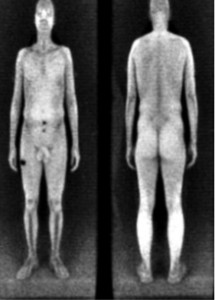
What happens with the scanners is that you walk through it, you pose, the scanner will scan you and the picture gets sent back to a TSA official in a back room. It is a very, very invasive picture. It shows cellulite. It shows love handles. It is very detailed and very graphic.
This sounds to me like a Moral Majority mailing to warn decent Christians about the detailed and graphic and explicit Gay Pride Parades that will teach fisting to kindergarteners. I can say in all seriousness that if a TSA employee is sexually aroused by the sight of my cellulite and love handles, I'd like to meet him. (And bear in mind that we're talking about a picture like this one, or these, which don't look like porn to me. But everyone has their own kink!) The sexual panic here, and in John Tyner's account of his refusal to submit to a patdown, is interesting. (I've read it repeatedly, and it sounds to me as if he didn't object to the patdown as long as he thought a female agent would be doing it; only when a male agent walked up to him did he freak out. "I repeated that I felt what they were doing was a sexual assault, and that if they were anyone but the government, the act would be illegal." Yes, and if a prostate exam were done in a prison shower instead of your doctor's office, it would be sodomy. Nor does the description of the patdown sound like "groping" to me, but whatever turns Tyner on...)

As I said before, there are good reasons to be skeptical of the scanners, including health risks from the radiation. Why not attend to them, instead of trying to stir up a Christian-Right style sexual panic? What depresses me is that this is coming from the left(ish) civil liberties groups and venues, as well as the usual Republican "middle-aged outrageaholics who suspect TSA employees are leering at them", as Roy Edroso describes them -- apparently not having noticed that the outrageaholics are bipartisan. One of Edroso's commenters gripes, "What pisses me off is that the Republicans know exactly what to do with these panic/fear states and the Democrats never do." As if "these panic/fear states" were just, like, Acts of God, things that happened with no human input! Democrats are helping the Republicans stir up the fear.

A number of people have echoed the idea that "we" fly too much. How much is too much? A number of Edroso's commenters batted back and forth the discomforts of flight in these post-9/11 times. Por ejemplo: "If I'm going to fly, the destination had better be fucking awesome to make up for the shit one has to put up with to travel by air. I'm not just talking about security stuff. It's everything. Plus, some people just don't get off on the whole travel thing -- while not thinking their own little hamlet is necessarily the best ever. Me personally? I would love to travel lots of places, just not by air." That's all very well, but it's wilfully irrelevant. It would be nice if every seat were first class, but then air travel wouldn't be affordable for as many people as it is. And I'm not sure that the discomforts of coach class (with which I'm well acquainted) are greater than those of steerage a hundred or so years ago.

The question that needs to be addressed is: if people are going to travel by air in large numbers, what are effective methods of managing security without compromising passengers' rights? One way to lower risk would be for countries like the US to stop the wholesale murder of large numbers of innocent people in other countries, inspiring survivors to seek redress for their grievances through retail violence. That's not likely to change in the foreseeable future, but it is something to bear in mind over the long term. How much good the increasingly intrusive security measures actually do is questionable -- they're usually closing the barn door after the horses have gotten out -- and because of the insecurity and uncertainty involved in these decisions, they can't be resolved with any finality. As this writer says,
Advocates of the 'security' perspective see nothing objectionable in 'sacrificing' personal privacy to the imperatives of greater air safety and believe the new machines are an inescapable imperative, exhorting those who are unwilling to submit to invasive scrutiny to 'take a car or a train'. Rights activists, on the other hand, have taken recourse to emotive images of a 'virtual strip search' by what has evocatively been dubbed the 'naked machine', to create the threat of an intolerable invasion of privacy by a technology that would expose 'body shapes and private parts', and that would be susceptible to abuse - particularly in the case of celebrities - notwithstanding any safeguards regulators may impose. One rights activist thus argues, persuasively, "We would certainly all be safer on airlines if we all flew naked." Evidently, that is an option few of us would seriously examine, irrespective of threat assessments.

... Knee jerk reactions have been the hallmark of Indian responses - and there is no visible reason why anything will change in the case of full body scanners at airports.
Kneejerk reactions have been the hallmark of American responses too: liberals and Democrats jumped onto Bush's bandwagon of domestic repression and foreign killing immediately after the September 11 attacks. My usual assessment of those who rely on "emotive images" rather than rational argument is that they don't have any rational arguments, or they'd use them. I suppose I'm sympathetic to people whose bodily modesty causes them to panic at the thought that a TSA employee in a back room will 'see them naked', or who can't stand to be touched in a patdown, and I count myself lucky, not virtuous, that neither prospect upsets me much, any more than the prospect of having my genitals inspected by a doctor of either sex. (The same goes for men who go into hysterics at the sight of other men's genitals, or even a CGI simulacrum of same: sucks to be them. They should be helped, but their phobia should not be treated as principled, let alone as Natural Law.)

But I don't trust Homeland Security or the rest of my government either. It's legitimate to doubt their claims of expertise about security when, as another Edroso commenter pointed out,
A month before Abdulmutallab got on a plane, his father told the State Dept. he was a terrorist. End result? Never on a no-fly list and gets on a plane in Holland without a passport because someone says he's a Sudanese refugee, and now everyone randomly (ooh, that's smart!) has to be felt up or sprayed with x-rays. Is that a fix for the real problem--an incompetent and busted early-warning system--or is it more security kabuki to give Homeland Security the illusion that they're doing their jobs?
Just as with the idea of letting civilians around the world live in peace, the remedy for airline security is probably more low-tech: pay attention to the information they actually get. But expensive technology is highly visible, media-friendly, and creates profits for those who are already rich.

Reading IOZ' recent posts on this subject reminds me that I really need to read more of the literature of anarchism, because leaving aside the question of how we get from here to there, I am not sure what an ideally coercion-free society is supposed to look like. How would airline security be handled under anarchy -- or would there be airlines, or air travel, at all? John Tyner reports that the agent who was supposed to do his patdown "said that I gave up a lot of rights when I bought my ticket. I replied that the government took them away after September 11th." Really? Does he think that an event like the September 11th attacks would have no effects on air travel if the government hadn't done anything? Airliners are expensive babies, and using them as projectiles to kill thousands of people is bad PR, bad for business. I would expect the corporations that handle air travel to take security measures of their own whether the government did anything or not, and since corporations are totalitarian organizations with little accountability, I wouldn't assume that they'd be less draconian, more sensible, or more effective than those of the TSA. (Remember, it wasn't "the government" who asked for the full-body scanners -- it was some companies that invented them and found ways to sell them to TSA (which -- surprise, surprise! -- was intimately connected to the corporations), over the objections of Congress.) Does buying a ticket give one a "right" to walk onto an airliner just as one wishes? Or does the vendor have the "right" to impose conditions under which they will allow you onto their property? Is there an implied contract, or a real one, in the fine print when you buy a ticket, that does waive certain of your rights? If we decide, kneejerkwise, that air travel should be a government-run project, I still am not sure that would change things much.

We come up against questions like: What are "reasonable" security concerns? What is a "reasonable" search? Does submitting to a search in order to board a plane constitute overt collaboration with Big Brother? I don't think consensus would be reached easily under the best imaginable conditions, and the quality of the discourse at the moment reminds me that we don't live in the best imaginable conditions.

Don't Touch Your What?

There's evidently reason to doubt the effectiveness of the full-body scanners that have been installed in many American airports, enough reason that the House of Representatives voted overwhelmingly last December against funding them. The ACLU and the National Rifle Association (!) backed this decision. The TSA responded by using stimulus funds to purchase the machines. According to the GAO, the scanners would not have caught the more recent terrorist-wannabe's who are used as the excuse for buying and using them. The former head of Homeland Security, Michael Chertoff, just happens to run a "consulting" firm among whose clients is the manufacturer of the scanners in question, but he prefers not to mention this when shilling for them. And now, as everyone has been hearing, persons passing through airport security must choose between a body scan and a thorough ("enhanced" is one adjective I've seen used) patdown by TSA personnel.

So I'd say it's rational to object to both the scanners and the patdowns. But instead working with the reasons, numerous liberal and progressive sources are being as alarmist as possible. The scanners are "x-rated," "porno scanners," "naked scanners." (Even the right-wing Washington Examiner likes that last one.) A good example comes from a travel blogger who heralds a new "privacy upgrade" on the scanners by opining, "I think most people would agree that the latest installation of full body (read: naked) airport scanners are … well … icky." Well, I'm not most people. I think that being blown into tiny little pieces is icky, whether it's done by an angry person on an airliner or by a crazed American President with a predator drone, but a full-body scan -- through your clothes, therefore not "naked" -- whatever else you can say about it, is not. Whether it's a necessary security measure is another question.

Ginger McCall, assistant director of the open government program at the Electronic Privacy Information Center, told Democracy Now! this morning:
What happens with the scanners is that you walk through it, you pose, the scanner will scan you and the picture gets sent back to a TSA official in a back room. It is a very, very invasive picture. It shows cellulite. It shows love handles. It is very detailed and very graphic.
This sounds to me like a Moral Majority mailing to warn decent Christians about the detailed and graphic and explicit Gay Pride Parades that will teach fisting to kindergarteners. I can say in all seriousness that if a TSA employee is sexually aroused by the sight of my cellulite and love handles, I'd like to meet him. (And bear in mind that we're talking about a picture like this one, or these, which don't look like porn to me. But everyone has their own kink!) The sexual panic here, and in John Tyner's account of his refusal to submit to a patdown, is interesting. (I've read it repeatedly, and it sounds to me as if he didn't object to the patdown as long as he thought a female agent would be doing it; only when a male agent walked up to him did he freak out. "I repeated that I felt what they were doing was a sexual assault, and that if they were anyone but the government, the act would be illegal." Yes, and if a prostate exam were done in a prison shower instead of your doctor's office, it would be sodomy. Nor does the description of the patdown sound like "groping" to me, but whatever turns Tyner on...)

As I said before, there are good reasons to be skeptical of the scanners, including health risks from the radiation. Why not attend to them, instead of trying to stir up a Christian-Right style sexual panic? What depresses me is that this is coming from the left(ish) civil liberties groups and venues, as well as the usual Republican "middle-aged outrageaholics who suspect TSA employees are leering at them", as Roy Edroso describes them -- apparently not having noticed that the outrageaholics are bipartisan. One of Edroso's commenters gripes, "What pisses me off is that the Republicans know exactly what to do with these panic/fear states and the Democrats never do." As if "these panic/fear states" were just, like, Acts of God, things that happened with no human input! Democrats are helping the Republicans stir up the fear.

A number of people have echoed the idea that "we" fly too much. How much is too much? A number of Edroso's commenters batted back and forth the discomforts of flight in these post-9/11 times. Por ejemplo: "If I'm going to fly, the destination had better be fucking awesome to make up for the shit one has to put up with to travel by air. I'm not just talking about security stuff. It's everything. Plus, some people just don't get off on the whole travel thing -- while not thinking their own little hamlet is necessarily the best ever. Me personally? I would love to travel lots of places, just not by air." That's all very well, but it's wilfully irrelevant. It would be nice if every seat were first class, but then air travel wouldn't be affordable for as many people as it is. And I'm not sure that the discomforts of coach class (with which I'm well acquainted) are greater than those of steerage a hundred or so years ago.

The question that needs to be addressed is: if people are going to travel by air in large numbers, what are effective methods of managing security without compromising passengers' rights? One way to lower risk would be for countries like the US to stop the wholesale murder of large numbers of innocent people in other countries, inspiring survivors to seek redress for their grievances through retail violence. That's not likely to change in the foreseeable future, but it is something to bear in mind over the long term. How much good the increasingly intrusive security measures actually do is questionable -- they're usually closing the barn door after the horses have gotten out -- and because of the insecurity and uncertainty involved in these decisions, they can't be resolved with any finality. As this writer says,
Advocates of the 'security' perspective see nothing objectionable in 'sacrificing' personal privacy to the imperatives of greater air safety and believe the new machines are an inescapable imperative, exhorting those who are unwilling to submit to invasive scrutiny to 'take a car or a train'. Rights activists, on the other hand, have taken recourse to emotive images of a 'virtual strip search' by what has evocatively been dubbed the 'naked machine', to create the threat of an intolerable invasion of privacy by a technology that would expose 'body shapes and private parts', and that would be susceptible to abuse - particularly in the case of celebrities - notwithstanding any safeguards regulators may impose. One rights activist thus argues, persuasively, "We would certainly all be safer on airlines if we all flew naked." Evidently, that is an option few of us would seriously examine, irrespective of threat assessments.

... Knee jerk reactions have been the hallmark of Indian responses - and there is no visible reason why anything will change in the case of full body scanners at airports.
Kneejerk reactions have been the hallmark of American responses too: liberals and Democrats jumped onto Bush's bandwagon of domestic repression and foreign killing immediately after the September 11 attacks. My usual assessment of those who rely on "emotive images" rather than rational argument is that they don't have any rational arguments, or they'd use them. I suppose I'm sympathetic to people whose bodily modesty causes them to panic at the thought that a TSA employee in a back room will 'see them naked', or who can't stand to be touched in a patdown, and I count myself lucky, not virtuous, that neither prospect upsets me much, any more than the prospect of having my genitals inspected by a doctor of either sex. (The same goes for men who go into hysterics at the sight of other men's genitals, or even a CGI simulacrum of same: sucks to be them. They should be helped, but their phobia should not be treated as principled, let alone as Natural Law.)

But I don't trust Homeland Security or the rest of my government either. It's legitimate to doubt their claims of expertise about security when, as another Edroso commenter pointed out,
A month before Abdulmutallab got on a plane, his father told the State Dept. he was a terrorist. End result? Never on a no-fly list and gets on a plane in Holland without a passport because someone says he's a Sudanese refugee, and now everyone randomly (ooh, that's smart!) has to be felt up or sprayed with x-rays. Is that a fix for the real problem--an incompetent and busted early-warning system--or is it more security kabuki to give Homeland Security the illusion that they're doing their jobs?
Just as with the idea of letting civilians around the world live in peace, the remedy for airline security is probably more low-tech: pay attention to the information they actually get. But expensive technology is highly visible, media-friendly, and creates profits for those who are already rich.

Reading IOZ' recent posts on this subject reminds me that I really need to read more of the literature of anarchism, because leaving aside the question of how we get from here to there, I am not sure what an ideally coercion-free society is supposed to look like. How would airline security be handled under anarchy -- or would there be airlines, or air travel, at all? John Tyner reports that the agent who was supposed to do his patdown "said that I gave up a lot of rights when I bought my ticket. I replied that the government took them away after September 11th." Really? Does he think that an event like the September 11th attacks would have no effects on air travel if the government hadn't done anything? Airliners are expensive babies, and using them as projectiles to kill thousands of people is bad PR, bad for business. I would expect the corporations that handle air travel to take security measures of their own whether the government did anything or not, and since corporations are totalitarian organizations with little accountability, I wouldn't assume that they'd be less draconian, more sensible, or more effective than those of the TSA. (Remember, it wasn't "the government" who asked for the full-body scanners -- it was some companies that invented them and found ways to sell them to TSA (which -- surprise, surprise! -- was intimately connected to the corporations), over the objections of Congress.) Does buying a ticket give one a "right" to walk onto an airliner just as one wishes? Or does the vendor have the "right" to impose conditions under which they will allow you onto their property? Is there an implied contract, or a real one, in the fine print when you buy a ticket, that does waive certain of your rights? If we decide, kneejerkwise, that air travel should be a government-run project, I still am not sure that would change things much.

We come up against questions like: What are "reasonable" security concerns? What is a "reasonable" search? Does submitting to a search in order to board a plane constitute overt collaboration with Big Brother? I don't think consensus would be reached easily under the best imaginable conditions, and the quality of the discourse at the moment reminds me that we don't live in the best imaginable conditions.