As for the argument from popularity, an odd conceit of a man plainly much-steeped in democracy, that Truth proceeds from the number of voters pulling the Yes lever, it would certainly dismay the early Christians scratching their little fishies in the sand. It did remind me of a good story the rabbi at my parents' synagogue told when I recently joined them at services for my brother's Yahrtzeit. Two orthodox rebbeim are debating the coming of the Moshiach. The first says, "I believe we must study Torah and observe the laws and traditions of our ancestors and not think too much of worldly things, for after all, when the Moshiach comes, many worldly things will pass away."
The second rebbe says, "I agree, we must read Torah and observe the laws and traditions, but should we not also work and pray for a better world for ourselves and our children and grandchildren? For after all, we do not know when the Moshiach will come. We do not even know if the Moshiach will come!"
"My friend!" cries the first rebbe. "How can you say such a thing? Does not Hashem promise that our Moshiach will come? Do you doubt the word of the Lord?"
"Hmmm," muses the first Rebbe. "Perhaps, perhaps."
"Aha!" the first rebbe calls out. "Then you do not believe in God!"
"Oh," the second replies. "Nonsense. I am a Jew. I believe in God. I just don't trust him."
Showing posts with label faith. Show all posts
Showing posts with label faith. Show all posts
Believing In Them Just Encourages Them
From Monsieur l'IOZ, one of the few other atheists on the Intertoobz I can read anymore without (most of the time) nausea:
Believing In Them Just Encourages Them
From Monsieur l'IOZ, one of the few other atheists on the Intertoobz I can read anymore without (most of the time) nausea:
As for the argument from popularity, an odd conceit of a man plainly much-steeped in democracy, that Truth proceeds from the number of voters pulling the Yes lever, it would certainly dismay the early Christians scratching their little fishies in the sand. It did remind me of a good story the rabbi at my parents' synagogue told when I recently joined them at services for my brother's Yahrtzeit. Two orthodox rebbeim are debating the coming of the Moshiach. The first says, "I believe we must study Torah and observe the laws and traditions of our ancestors and not think too much of worldly things, for after all, when the Moshiach comes, many worldly things will pass away."
The second rebbe says, "I agree, we must read Torah and observe the laws and traditions, but should we not also work and pray for a better world for ourselves and our children and grandchildren? For after all, we do not know when the Moshiach will come. We do not even know if the Moshiach will come!"
"My friend!" cries the first rebbe. "How can you say such a thing? Does not Hashem promise that our Moshiach will come? Do you doubt the word of the Lord?"
"Hmmm," muses the first Rebbe. "Perhaps, perhaps."
"Aha!" the first rebbe calls out. "Then you do not believe in God!"
"Oh," the second replies. "Nonsense. I am a Jew. I believe in God. I just don't trust him."
Faith Against Faith
But I was going to write about faith.
I picked David Fergusson's Faith and Its Critics: A Conversation (Oxford, 2009) off the new arrivals shelves at the university library. It looked like a short, easy read, a response to the New Atheists in the form of the Gifford Lectures for 2008, but the subtitle was troublesome. Giving a lecture, writing a book, is not a conversation; it may be "an invitation to engage in a rich dialogue" as the book's publisher claims, but it's still just an extended monologue.
So I wasn't expecting much, but Faith and Its Critics was still something of a disappointment. Whatever my differences with the New Atheists, they have succeeded in putting theists on the defensive. The traditional "proofs" or arguments for the existence of gods have largely been abandoned, even by theists; reactionary fundamentalism embarrasses nice, respectable believers; and the New Atheists are so negative, so harsh. So it's not surprising that many theists are trying to reach out to more moderate atheists, presenting themselves as voices of reason and moderation. Fergusson, for example, singles out
Even the New Atheists agree that religion and atheism share "common ground." That's just what has their pants in a bunch: religion claims certain realms of human thought and action for its turf, notably morality, and the New Atheists don't want to let them have it. They want Science and Rationality to rule, though Science and Rationality have done no better on that turf than Religion has. Here I'd throw down the gauntlet of the Presumption of Atheism: the burden of proof lies on the person who claims that there is are gods and that they have opinions that I should take seriously. But I don't think that believers are wholly Other -- that, if anything, is what bothers them. They can't appeal to their gods' authority, because, first, I don't recognize that their gods have any authority; second, because the burden of proof is on them to show that they know their gods' opinions reliably.
I'm the first to admit that there are articulate and decent Christians, though I don't see why I should judge Christianity by them any more than I should judge Christianity by the inarticulate and indecent Christians. I presume that Fergusson takes for granted that he's one of the articulate and decent, but if so, he doesn't do a very good job of articulating a position I can have a conversation with.
For example, he keeps playing games with the word faith. "In the west, atheism has come to be associated with the rejection of the God of the Christian faith, or the God of Judeo-Christian theism, or still more broadly the God of the three Abrahamic faiths" (17). In these ecumenical, diverse and multicultural times, it is bad form to badmouth what used to be called paganism, but it soon becomes clear that by "faith" Fergusson doesn't mean to include worship of the old Greek, Roman, Norse or other non-Yahwist gods. That's the kindest construction I can put on such statements as
Jesus is even harder to evaluate, because Christians have never been able to make up their minds why he was executed. Though it's pretty certain that he was killed by the Romans, and the gospels agree that he was crucified as "King of the Jews," the gospels don't show clearly how this charge came to be brought against him. He never claims that title in the gospels, and it has no importance in Christian doctrine. The gospels are more clear that Jesus' death resulted from conflict between Jesus and other Jews (who also had faith and a tradition of martyrdom), but no plausible charge is raised against him -- claiming to be the Messiah is not a crime under Jewish law, for example. "False witnesses" claimed that Jesus had made some sort of threat against the Jerusalem Temple, but these accusations seem not be have determined his death either. And according to Christian mythology, Jesus died as a sacrifice for the sins of humanity, so his execution was not due to a conflict between faiths but was the will of Yahweh; Jesus' enemies were unknowing pawns in the Father's game. We don't even know that, as Fergusson claims, "Jesus goes to his death willingly but passively" (129). The writers of the gospels probably had no better information about how Jesus faced his death than they did about why he died, so they probably depicted him acting as a faithful martyr should act. [P.S. But at the same time, the Gospel of John shows Jesus marching quite actively to his martyrdom, and the others should also be read in the light of the belief, accurate or not, that Jesus expected and sought his death.]
Most of Faith and Its Critics consists of rambling discussions of modern science and modern faith, how they don't have to conflict but can be reconciled. He devotes a fair amount of time to rebutting Richard Dawkins, not very effectively. For example:
Fergusson evades the difficulties of biblical material by invoking non-literal interpretation.
The closest Fergusson comes to making clear what he means by pathological expressions of faith is when he touches on terrorism by Islamic fundamentalists.
Fergusson sweeps a lot of Yahwist history under the rug, and gets wrong a lot of what he does mention.
I myself don't blame religion for human violence, because I regard religion as a human invention. To blame atrocities on religion is to take religion at its own estimation as an autonomous, superhuman (or other-than-human) force; I blame them on human beings projecting their own attitudes onto their gods and getting them back endowed with authority. This also means, however, that the good things about human beings are also our doing. I think we can do better, but I'm not sure I have much faith in that possibility. One way to advance in that direction, I think, is for human beings to own all our actions, instead of crediting gods for them for better or worse.
I picked David Fergusson's Faith and Its Critics: A Conversation (Oxford, 2009) off the new arrivals shelves at the university library. It looked like a short, easy read, a response to the New Atheists in the form of the Gifford Lectures for 2008, but the subtitle was troublesome. Giving a lecture, writing a book, is not a conversation; it may be "an invitation to engage in a rich dialogue" as the book's publisher claims, but it's still just an extended monologue.
So I wasn't expecting much, but Faith and Its Critics was still something of a disappointment. Whatever my differences with the New Atheists, they have succeeded in putting theists on the defensive. The traditional "proofs" or arguments for the existence of gods have largely been abandoned, even by theists; reactionary fundamentalism embarrasses nice, respectable believers; and the New Atheists are so negative, so harsh. So it's not surprising that many theists are trying to reach out to more moderate atheists, presenting themselves as voices of reason and moderation. Fergusson, for example, singles out
Edward O. Wilson, a leading exponent of sociobiology, [who] claims that we do not know enough to pronounce on the truth claims of religion but we can at least recognize that it has its articulate and decent defenders. Describing himself as on the diplomatic rather than militant wing of secularism, he searches for common ground with religion."Articulate and decent defenders"! "The middle ground of skepticism and faith"! I'm not much for the middle ground, since any position can occupy the middle ground if you get to define the extremes. As Ellen Willis once defined it satirically, “For example, the feminist bias is that women are equal to men and the male chauvinist bias is that women are inferior to men. The unbiased view is that the truth lies somewhere in between.” (“Glossary for the Eighties,” reprinted in Beginning to See the Light, [Knopf 1981], p. 146)
In what follows, my claim is that a conversation needs to be established between those occupying the middle ground of skepticism and faith, where each side recognizes that it has something to learn from the other whether that is about the persistence of faith or its many pathological expressions in the world. This, moreover, may be a moral imperative in today’s world where international cooperation and cross-faith alliances are increasingly needed [12].
Even the New Atheists agree that religion and atheism share "common ground." That's just what has their pants in a bunch: religion claims certain realms of human thought and action for its turf, notably morality, and the New Atheists don't want to let them have it. They want Science and Rationality to rule, though Science and Rationality have done no better on that turf than Religion has. Here I'd throw down the gauntlet of the Presumption of Atheism: the burden of proof lies on the person who claims that there is are gods and that they have opinions that I should take seriously. But I don't think that believers are wholly Other -- that, if anything, is what bothers them. They can't appeal to their gods' authority, because, first, I don't recognize that their gods have any authority; second, because the burden of proof is on them to show that they know their gods' opinions reliably.
I'm the first to admit that there are articulate and decent Christians, though I don't see why I should judge Christianity by them any more than I should judge Christianity by the inarticulate and indecent Christians. I presume that Fergusson takes for granted that he's one of the articulate and decent, but if so, he doesn't do a very good job of articulating a position I can have a conversation with.
For example, he keeps playing games with the word faith. "In the west, atheism has come to be associated with the rejection of the God of the Christian faith, or the God of Judeo-Christian theism, or still more broadly the God of the three Abrahamic faiths" (17). In these ecumenical, diverse and multicultural times, it is bad form to badmouth what used to be called paganism, but it soon becomes clear that by "faith" Fergusson doesn't mean to include worship of the old Greek, Roman, Norse or other non-Yahwist gods. That's the kindest construction I can put on such statements as
Like Socrates and Jesus before him, Justin [Martyr] is martyred for his faith [15].Those who martyred Socrates, Jesus, and Justin also had faith, remember. But their faith seems not to count; perhaps it was what Fergusson conveniently calls "pathological expressions" -- all things are possible for him who gets to diagnose pathology. And while it's probably fair to say that Justin was executed for his "faith," which required him to reject the dominant faiths of the Roman Empire in his day, it's not nearly so clear that Socrates and Jesus died because of their "faith." Socrates got into political trouble, and chose to accept execution by poisoning rather than change his conduct or political beliefs, or even to leave Athens. Going by his example, just about anyone who's ever been killed by other human beings could be said to have died for his or her "faith": Trotsky, say, or John Wilkes Booth. Fergusson's invocation of pathology is a reminder that willingness to die for one's "faith" is no warrant of that faith's validity, but he offers no criteria for telling healthy faith from pathological faith.
Jesus is even harder to evaluate, because Christians have never been able to make up their minds why he was executed. Though it's pretty certain that he was killed by the Romans, and the gospels agree that he was crucified as "King of the Jews," the gospels don't show clearly how this charge came to be brought against him. He never claims that title in the gospels, and it has no importance in Christian doctrine. The gospels are more clear that Jesus' death resulted from conflict between Jesus and other Jews (who also had faith and a tradition of martyrdom), but no plausible charge is raised against him -- claiming to be the Messiah is not a crime under Jewish law, for example. "False witnesses" claimed that Jesus had made some sort of threat against the Jerusalem Temple, but these accusations seem not be have determined his death either. And according to Christian mythology, Jesus died as a sacrifice for the sins of humanity, so his execution was not due to a conflict between faiths but was the will of Yahweh; Jesus' enemies were unknowing pawns in the Father's game. We don't even know that, as Fergusson claims, "Jesus goes to his death willingly but passively" (129). The writers of the gospels probably had no better information about how Jesus faced his death than they did about why he died, so they probably depicted him acting as a faithful martyr should act. [P.S. But at the same time, the Gospel of John shows Jesus marching quite actively to his martyrdom, and the others should also be read in the light of the belief, accurate or not, that Jesus expected and sought his death.]
Most of Faith and Its Critics consists of rambling discussions of modern science and modern faith, how they don't have to conflict but can be reconciled. He devotes a fair amount of time to rebutting Richard Dawkins, not very effectively. For example:
… for example, the grisly stories recounted by Dawkins of children being subjected to movies about the likely conditions of hell in order to constrain their behaviour. However, once again the pathological examples that are adduced do not confirm the hypothesis that religious nurture amounts to brainwashing, let alone abuse. The forms of Christian education with which we are familiar in our churches and schools often enable youngsters to develop skills of discernment and interpretation. They are given freedom and encouragement to make responsible decisions for themselves as they reach adulthood.I wonder which "forms of Christian education" Fergusson is familiar with, but he seems to be whitewashing the problem. Once again, he brushes aside inconvenient "faith" behavior as "pathological." Teaching children -- or adults, for that matter -- about Hell is hardly marginal in Christianity, having its roots in Jesus' teachings and carrying down through the centuries. If Sunday School teachers nowadays aren't all that influential on young people's consciousness, it is precisely because faith isn't as powerful as it used to be, the very situation Fergusson deplores. In this respect he's like many liberal Christians and even ex-Christians I've talked to, who don't recall hearing much about Hell at church during their childhoods: this means they have not been educated accurately about historical Christianity. [P.S. Or that they've forgotten what they were taught, which I think is equally likely.] They certainly don't show any sign of having been taught "skills of discernment and interpretation."
If there is any brainwashing in our culture then it is surely the sort that derives from peer-group pressure and the media. These function far more powerfully in the consciousness of children and teenagers than do the strictures of their Sunday School teachers [143-4].
Fergusson evades the difficulties of biblical material by invoking non-literal interpretation.
Non-literal, symbolic readings are not the invention of recent critics influenced by secular trends [157].Heavens! Does Dawkins believe so? According to Fergusson, "All we are told [by Dawkins] is that a symbolic reading of difficult passages is a ‘favourite trick’ of religious leaders" (152; citing The God Delusion, 247). Then Dawkins is even stupider than I thought. Of course non-literal readings of high-status texts are nothing new, and the kind Fergusson has in mind are the special province of fundamentalism; they certainly aren't automatically correct.
One distinct advantage offered by this account of the layered meaning of the Scriptural text was that it could accommodate a critical attitude towards those passages that were adjudged morally unacceptable. Where they departed from the teaching and example of Christ, a meaning other than the literal had to be sought [158].But what if Jesus' teaching and example are morally unacceptable? This seems to be unthinkable for Fergusson, but an atheist, even the moderate sort he imagines himself to be addressing, needn't agree. Since the gospels are virtually the only source of information we have about Jesus' teaching and example, problematic passages can't be disposed of that easily.
The closest Fergusson comes to making clear what he means by pathological expressions of faith is when he touches on terrorism by Islamic fundamentalists.
In the case of recent predatory martyrdom, this is usually an indiscriminate attack on anyone in the target area, whether these are soldiers, civilians, children, sick or disabled persons [132].The chief difference between this and US and British practice is that we kill the innocent without risking ourselves. Fergusson has nothing to say about secular, let alone Christian homicide bombing, which has killed many more innocent people than suicide bombers have.
Contrast this with the ideology of Al-Qaeda and its brand of global terrorism, which renders any Western city a potential target whether New York, Madrid, London, or Glasgow. Here there is no overriding commitment to a single political collective or local cause. It is a movement that rejects the spread of a global culture – its cities are rootless and godless places in which to live; its political might has oppressed the heartlands of Islam in the middle east; and its client state Israel, a small nation, has humiliated its larger neighbours and displaced its indigenous Muslim population. Moreover, the terror of this movement is largely nihilistic [133].Fergusson gives no cites for this claim, but the word "nihilistic" suggests he's read Paul Berman's Terror and Liberalism.
On the other hand one can also find a corresponding contribution of religion to the flourishing of civilizations, their cultural achievements, and the peaceful co-existence of peoples of different race, language, and religion [137]. ...It's not always a good thing to be "civil and law-abiding neighbors," of course: think of the good Germans who peacefully stood by while their German Jewish neighbors were taken away. (The history of Christian anti-Semitism, while no doubt "pathological" in Fergusson's scorebook, gets short shrift here.) Think of American Christians who opposed the abolition of slavery, and who maintained racist social structures well into the second half of the twentieth century. Think of the American Christian right, who "by their own testimony" are peaceful citizens and only request a fair hearing. The early exponents of Christian faith were disingenuous: far from being peaceable, they spent a lot of energy squabbling with each other, often to the point of violence, and as soon as they dared they extended that violence to "pagans."
At the same time, it should be remembered that the vast bulk of the adherents of all the world’s religions make civil and law-abiding neighbors. By their own testimony, their faith makes them more peaceable than they would otherwise be. … A fair hearing was what the early exponents of Christian faith requested of their pagan audiences and this ought still to be accorded people of good faith everywhere [140].
Fergusson sweeps a lot of Yahwist history under the rug, and gets wrong a lot of what he does mention.
A willingness to die in the service of God and the keeping of one’s faith is evident through much of the Hebrew Scriptures. It was a way of honouring God and maintaining the cause of God’s people, as in the examples of Daniel and the three men in the fiery furnace. In the inter-testamental period, the example of the Maccabean martyrs extends this further [128].A willingness to kill in the service of God is even more evident in the Hebrew Scriptures, much more than martyrdom. Whether against non-Hebrews, as in the conquest of Canaan, or within the nation, as in the "reforms" which enforced monotheism, the Hebrew Bible is hardly a model of pacifistic tolerance. Ditto for Jesus, whose preaching is suffused with threats of eternal torture, a theme that the early churches elaborated with gusto. When he acknowledges contemporary cases -- Serbia, Rwanda, Israel / Palestine, Northern Ireland -- he blames it all on 'sectarianism' (124), which is to say, faith.
I myself don't blame religion for human violence, because I regard religion as a human invention. To blame atrocities on religion is to take religion at its own estimation as an autonomous, superhuman (or other-than-human) force; I blame them on human beings projecting their own attitudes onto their gods and getting them back endowed with authority. This also means, however, that the good things about human beings are also our doing. I think we can do better, but I'm not sure I have much faith in that possibility. One way to advance in that direction, I think, is for human beings to own all our actions, instead of crediting gods for them for better or worse.
Faith Against Faith
But I was going to write about faith.
I picked David Fergusson's Faith and Its Critics: A Conversation (Oxford, 2009) off the new arrivals shelves at the university library. It looked like a short, easy read, a response to the New Atheists in the form of the Gifford Lectures for 2008, but the subtitle was troublesome. Giving a lecture, writing a book, is not a conversation; it may be "an invitation to engage in a rich dialogue" as the book's publisher claims, but it's still just an extended monologue.
So I wasn't expecting much, but Faith and Its Critics was still something of a disappointment. Whatever my differences with the New Atheists, they have succeeded in putting theists on the defensive. The traditional "proofs" or arguments for the existence of gods have largely been abandoned, even by theists; reactionary fundamentalism embarrasses nice, respectable believers; and the New Atheists are so negative, so harsh. So it's not surprising that many theists are trying to reach out to more moderate atheists, presenting themselves as voices of reason and moderation. Fergusson, for example, singles out
Even the New Atheists agree that religion and atheism share "common ground." That's just what has their pants in a bunch: religion claims certain realms of human thought and action for its turf, notably morality, and the New Atheists don't want to let them have it. They want Science and Rationality to rule, though Science and Rationality have done no better on that turf than Religion has. Here I'd throw down the gauntlet of the Presumption of Atheism: the burden of proof lies on the person who claims that there is are gods and that they have opinions that I should take seriously. But I don't think that believers are wholly Other -- that, if anything, is what bothers them. They can't appeal to their gods' authority, because, first, I don't recognize that their gods have any authority; second, because the burden of proof is on them to show that they know their gods' opinions reliably.
I'm the first to admit that there are articulate and decent Christians, though I don't see why I should judge Christianity by them any more than I should judge Christianity by the inarticulate and indecent Christians. I presume that Fergusson takes for granted that he's one of the articulate and decent, but if so, he doesn't do a very good job of articulating a position I can have a conversation with.
For example, he keeps playing games with the word faith. "In the west, atheism has come to be associated with the rejection of the God of the Christian faith, or the God of Judeo-Christian theism, or still more broadly the God of the three Abrahamic faiths" (17). In these ecumenical, diverse and multicultural times, it is bad form to badmouth what used to be called paganism, but it soon becomes clear that by "faith" Fergusson doesn't mean to include worship of the old Greek, Roman, Norse or other non-Yahwist gods. That's the kindest construction I can put on such statements as
Jesus is even harder to evaluate, because Christians have never been able to make up their minds why he was executed. Though it's pretty certain that he was killed by the Romans, and the gospels agree that he was crucified as "King of the Jews," the gospels don't show clearly how this charge came to be brought against him. He never claims that title in the gospels, and it has no importance in Christian doctrine. The gospels are more clear that Jesus' death resulted from conflict between Jesus and other Jews (who also had faith and a tradition of martyrdom), but no plausible charge is raised against him -- claiming to be the Messiah is not a crime under Jewish law, for example. "False witnesses" claimed that Jesus had made some sort of threat against the Jerusalem Temple, but these accusations seem not be have determined his death either. And according to Christian mythology, Jesus died as a sacrifice for the sins of humanity, so his execution was not due to a conflict between faiths but was the will of Yahweh; Jesus' enemies were unknowing pawns in the Father's game. We don't even know that, as Fergusson claims, "Jesus goes to his death willingly but passively" (129). The writers of the gospels probably had no better information about how Jesus faced his death than they did about why he died, so they probably depicted him acting as a faithful martyr should act. [P.S. But at the same time, the Gospel of John shows Jesus marching quite actively to his martyrdom, and the others should also be read in the light of the belief, accurate or not, that Jesus expected and sought his death.]
Most of Faith and Its Critics consists of rambling discussions of modern science and modern faith, how they don't have to conflict but can be reconciled. He devotes a fair amount of time to rebutting Richard Dawkins, not very effectively. For example:
Fergusson evades the difficulties of biblical material by invoking non-literal interpretation.
The closest Fergusson comes to making clear what he means by pathological expressions of faith is when he touches on terrorism by Islamic fundamentalists.
Fergusson sweeps a lot of Yahwist history under the rug, and gets wrong a lot of what he does mention.
I myself don't blame religion for human violence, because I regard religion as a human invention. To blame atrocities on religion is to take religion at its own estimation as an autonomous, superhuman (or other-than-human) force; I blame them on human beings projecting their own attitudes onto their gods and getting them back endowed with authority. This also means, however, that the good things about human beings are also our doing. I think we can do better, but I'm not sure I have much faith in that possibility. One way to advance in that direction, I think, is for human beings to own all our actions, instead of crediting gods for them for better or worse.
I picked David Fergusson's Faith and Its Critics: A Conversation (Oxford, 2009) off the new arrivals shelves at the university library. It looked like a short, easy read, a response to the New Atheists in the form of the Gifford Lectures for 2008, but the subtitle was troublesome. Giving a lecture, writing a book, is not a conversation; it may be "an invitation to engage in a rich dialogue" as the book's publisher claims, but it's still just an extended monologue.
So I wasn't expecting much, but Faith and Its Critics was still something of a disappointment. Whatever my differences with the New Atheists, they have succeeded in putting theists on the defensive. The traditional "proofs" or arguments for the existence of gods have largely been abandoned, even by theists; reactionary fundamentalism embarrasses nice, respectable believers; and the New Atheists are so negative, so harsh. So it's not surprising that many theists are trying to reach out to more moderate atheists, presenting themselves as voices of reason and moderation. Fergusson, for example, singles out
Edward O. Wilson, a leading exponent of sociobiology, [who] claims that we do not know enough to pronounce on the truth claims of religion but we can at least recognize that it has its articulate and decent defenders. Describing himself as on the diplomatic rather than militant wing of secularism, he searches for common ground with religion."Articulate and decent defenders"! "The middle ground of skepticism and faith"! I'm not much for the middle ground, since any position can occupy the middle ground if you get to define the extremes. As Ellen Willis once defined it satirically, “For example, the feminist bias is that women are equal to men and the male chauvinist bias is that women are inferior to men. The unbiased view is that the truth lies somewhere in between.” (“Glossary for the Eighties,” reprinted in Beginning to See the Light, [Knopf 1981], p. 146)
In what follows, my claim is that a conversation needs to be established between those occupying the middle ground of skepticism and faith, where each side recognizes that it has something to learn from the other whether that is about the persistence of faith or its many pathological expressions in the world. This, moreover, may be a moral imperative in today’s world where international cooperation and cross-faith alliances are increasingly needed [12].
Even the New Atheists agree that religion and atheism share "common ground." That's just what has their pants in a bunch: religion claims certain realms of human thought and action for its turf, notably morality, and the New Atheists don't want to let them have it. They want Science and Rationality to rule, though Science and Rationality have done no better on that turf than Religion has. Here I'd throw down the gauntlet of the Presumption of Atheism: the burden of proof lies on the person who claims that there is are gods and that they have opinions that I should take seriously. But I don't think that believers are wholly Other -- that, if anything, is what bothers them. They can't appeal to their gods' authority, because, first, I don't recognize that their gods have any authority; second, because the burden of proof is on them to show that they know their gods' opinions reliably.
I'm the first to admit that there are articulate and decent Christians, though I don't see why I should judge Christianity by them any more than I should judge Christianity by the inarticulate and indecent Christians. I presume that Fergusson takes for granted that he's one of the articulate and decent, but if so, he doesn't do a very good job of articulating a position I can have a conversation with.
For example, he keeps playing games with the word faith. "In the west, atheism has come to be associated with the rejection of the God of the Christian faith, or the God of Judeo-Christian theism, or still more broadly the God of the three Abrahamic faiths" (17). In these ecumenical, diverse and multicultural times, it is bad form to badmouth what used to be called paganism, but it soon becomes clear that by "faith" Fergusson doesn't mean to include worship of the old Greek, Roman, Norse or other non-Yahwist gods. That's the kindest construction I can put on such statements as
Like Socrates and Jesus before him, Justin [Martyr] is martyred for his faith [15].Those who martyred Socrates, Jesus, and Justin also had faith, remember. But their faith seems not to count; perhaps it was what Fergusson conveniently calls "pathological expressions" -- all things are possible for him who gets to diagnose pathology. And while it's probably fair to say that Justin was executed for his "faith," which required him to reject the dominant faiths of the Roman Empire in his day, it's not nearly so clear that Socrates and Jesus died because of their "faith." Socrates got into political trouble, and chose to accept execution by poisoning rather than change his conduct or political beliefs, or even to leave Athens. Going by his example, just about anyone who's ever been killed by other human beings could be said to have died for his or her "faith": Trotsky, say, or John Wilkes Booth. Fergusson's invocation of pathology is a reminder that willingness to die for one's "faith" is no warrant of that faith's validity, but he offers no criteria for telling healthy faith from pathological faith.
Jesus is even harder to evaluate, because Christians have never been able to make up their minds why he was executed. Though it's pretty certain that he was killed by the Romans, and the gospels agree that he was crucified as "King of the Jews," the gospels don't show clearly how this charge came to be brought against him. He never claims that title in the gospels, and it has no importance in Christian doctrine. The gospels are more clear that Jesus' death resulted from conflict between Jesus and other Jews (who also had faith and a tradition of martyrdom), but no plausible charge is raised against him -- claiming to be the Messiah is not a crime under Jewish law, for example. "False witnesses" claimed that Jesus had made some sort of threat against the Jerusalem Temple, but these accusations seem not be have determined his death either. And according to Christian mythology, Jesus died as a sacrifice for the sins of humanity, so his execution was not due to a conflict between faiths but was the will of Yahweh; Jesus' enemies were unknowing pawns in the Father's game. We don't even know that, as Fergusson claims, "Jesus goes to his death willingly but passively" (129). The writers of the gospels probably had no better information about how Jesus faced his death than they did about why he died, so they probably depicted him acting as a faithful martyr should act. [P.S. But at the same time, the Gospel of John shows Jesus marching quite actively to his martyrdom, and the others should also be read in the light of the belief, accurate or not, that Jesus expected and sought his death.]
Most of Faith and Its Critics consists of rambling discussions of modern science and modern faith, how they don't have to conflict but can be reconciled. He devotes a fair amount of time to rebutting Richard Dawkins, not very effectively. For example:
… for example, the grisly stories recounted by Dawkins of children being subjected to movies about the likely conditions of hell in order to constrain their behaviour. However, once again the pathological examples that are adduced do not confirm the hypothesis that religious nurture amounts to brainwashing, let alone abuse. The forms of Christian education with which we are familiar in our churches and schools often enable youngsters to develop skills of discernment and interpretation. They are given freedom and encouragement to make responsible decisions for themselves as they reach adulthood.I wonder which "forms of Christian education" Fergusson is familiar with, but he seems to be whitewashing the problem. Once again, he brushes aside inconvenient "faith" behavior as "pathological." Teaching children -- or adults, for that matter -- about Hell is hardly marginal in Christianity, having its roots in Jesus' teachings and carrying down through the centuries. If Sunday School teachers nowadays aren't all that influential on young people's consciousness, it is precisely because faith isn't as powerful as it used to be, the very situation Fergusson deplores. In this respect he's like many liberal Christians and even ex-Christians I've talked to, who don't recall hearing much about Hell at church during their childhoods: this means they have not been educated accurately about historical Christianity. [P.S. Or that they've forgotten what they were taught, which I think is equally likely.] They certainly don't show any sign of having been taught "skills of discernment and interpretation."
If there is any brainwashing in our culture then it is surely the sort that derives from peer-group pressure and the media. These function far more powerfully in the consciousness of children and teenagers than do the strictures of their Sunday School teachers [143-4].
Fergusson evades the difficulties of biblical material by invoking non-literal interpretation.
Non-literal, symbolic readings are not the invention of recent critics influenced by secular trends [157].Heavens! Does Dawkins believe so? According to Fergusson, "All we are told [by Dawkins] is that a symbolic reading of difficult passages is a ‘favourite trick’ of religious leaders" (152; citing The God Delusion, 247). Then Dawkins is even stupider than I thought. Of course non-literal readings of high-status texts are nothing new, and the kind Fergusson has in mind are the special province of fundamentalism; they certainly aren't automatically correct.
One distinct advantage offered by this account of the layered meaning of the Scriptural text was that it could accommodate a critical attitude towards those passages that were adjudged morally unacceptable. Where they departed from the teaching and example of Christ, a meaning other than the literal had to be sought [158].But what if Jesus' teaching and example are morally unacceptable? This seems to be unthinkable for Fergusson, but an atheist, even the moderate sort he imagines himself to be addressing, needn't agree. Since the gospels are virtually the only source of information we have about Jesus' teaching and example, problematic passages can't be disposed of that easily.
The closest Fergusson comes to making clear what he means by pathological expressions of faith is when he touches on terrorism by Islamic fundamentalists.
In the case of recent predatory martyrdom, this is usually an indiscriminate attack on anyone in the target area, whether these are soldiers, civilians, children, sick or disabled persons [132].The chief difference between this and US and British practice is that we kill the innocent without risking ourselves. Fergusson has nothing to say about secular, let alone Christian homicide bombing, which has killed many more innocent people than suicide bombers have.
Contrast this with the ideology of Al-Qaeda and its brand of global terrorism, which renders any Western city a potential target whether New York, Madrid, London, or Glasgow. Here there is no overriding commitment to a single political collective or local cause. It is a movement that rejects the spread of a global culture – its cities are rootless and godless places in which to live; its political might has oppressed the heartlands of Islam in the middle east; and its client state Israel, a small nation, has humiliated its larger neighbours and displaced its indigenous Muslim population. Moreover, the terror of this movement is largely nihilistic [133].Fergusson gives no cites for this claim, but the word "nihilistic" suggests he's read Paul Berman's Terror and Liberalism.
On the other hand one can also find a corresponding contribution of religion to the flourishing of civilizations, their cultural achievements, and the peaceful co-existence of peoples of different race, language, and religion [137]. ...It's not always a good thing to be "civil and law-abiding neighbors," of course: think of the good Germans who peacefully stood by while their German Jewish neighbors were taken away. (The history of Christian anti-Semitism, while no doubt "pathological" in Fergusson's scorebook, gets short shrift here.) Think of American Christians who opposed the abolition of slavery, and who maintained racist social structures well into the second half of the twentieth century. Think of the American Christian right, who "by their own testimony" are peaceful citizens and only request a fair hearing. The early exponents of Christian faith were disingenuous: far from being peaceable, they spent a lot of energy squabbling with each other, often to the point of violence, and as soon as they dared they extended that violence to "pagans."
At the same time, it should be remembered that the vast bulk of the adherents of all the world’s religions make civil and law-abiding neighbors. By their own testimony, their faith makes them more peaceable than they would otherwise be. … A fair hearing was what the early exponents of Christian faith requested of their pagan audiences and this ought still to be accorded people of good faith everywhere [140].
Fergusson sweeps a lot of Yahwist history under the rug, and gets wrong a lot of what he does mention.
A willingness to die in the service of God and the keeping of one’s faith is evident through much of the Hebrew Scriptures. It was a way of honouring God and maintaining the cause of God’s people, as in the examples of Daniel and the three men in the fiery furnace. In the inter-testamental period, the example of the Maccabean martyrs extends this further [128].A willingness to kill in the service of God is even more evident in the Hebrew Scriptures, much more than martyrdom. Whether against non-Hebrews, as in the conquest of Canaan, or within the nation, as in the "reforms" which enforced monotheism, the Hebrew Bible is hardly a model of pacifistic tolerance. Ditto for Jesus, whose preaching is suffused with threats of eternal torture, a theme that the early churches elaborated with gusto. When he acknowledges contemporary cases -- Serbia, Rwanda, Israel / Palestine, Northern Ireland -- he blames it all on 'sectarianism' (124), which is to say, faith.
I myself don't blame religion for human violence, because I regard religion as a human invention. To blame atrocities on religion is to take religion at its own estimation as an autonomous, superhuman (or other-than-human) force; I blame them on human beings projecting their own attitudes onto their gods and getting them back endowed with authority. This also means, however, that the good things about human beings are also our doing. I think we can do better, but I'm not sure I have much faith in that possibility. One way to advance in that direction, I think, is for human beings to own all our actions, instead of crediting gods for them for better or worse.
Having Faith in Faith in Faith in Faith
I just finished reading 36 Arguments for the Existence of God: A Work of Fiction by Rebecca Newberger Goldstein. It's Goldstein's seventh novel (she's also written two nonfiction works on Godel's Proof and Baruch Spinoza), and it's the first book since her first, The Mind-Body Problem, that I've felt like re-reading. I want to write about it in more detail another time, but for now I want to focus on one of the issues it touches on without real depth.
The climax of 36 Arguments is a debate between the protagonist, lapsed-Hasidic atheist author Cass Seltzer and flamboyant Christian economist Felix Fidley on the existence of God. Fidley builds his case around the old chestnut that it takes as much faith to be an atheist as it takes to be a theist, and Seltzer doesn't do much with that in his rebuttal. I think I came up with a better one.
(Incidentally, Goldstein puts into Fidley's mouth the claim that the philosopher Bertrand Russell "said that the difference between faith and reason is like the difference between faith and honest toil" [302]. Actually what Russell said was: "The method of 'postulating' what we want has many advantages; they are the same as the advantages of theft over honest toil." He was writing about mathematics here, not religion. This is the kind of misrepresentation that is common among debaters, religious or otherwise. Goldstein, who's a philosopher herself, must surely have known the correct statement; I guess she decided to undercut her character. But she doesn't have Cass correct the error either.)
Many atheists respond to this move by arguing that atheism is not a matter of faith, that they believe nothing without good reason, and so on. Christopher Hitchens contributed a blurb to 36 Arguments, which sits atop the totem pole on the back cover: "You do not have to perpetrate an act of faith to confront the question of why there is something rather than nothing. It is faith itself that consists of nothing. Rebecca Goldstein, on the other hand, is quite something." (A blurb from Hitchens, by the way, is as discrediting here as a blurb from Alan Dershowitz was for Sam Harris's The End of Faith.) Of course "faith" consists of nothing -- like numbers, words, ideas, or any other abstraction, including reason.
Anyhow, I don't think this move really succeeds. The traditional arguments for the existence of God have been attacked so effectively in the past few centuries that most theistic philosophers have largely abandoned them. It seems to me that for the same reason, while atheism -- starting from the absence rather than the denial of god -- is a reasonable position to adopt, it can't be proven. It's a stance, an approach, rather than certain knowledge. I can't prove that the god of Christianity (for example) doesn't exist; however unlikely I think it is, for reasons that seem solid to me, it is conceivable that I'm wrong and that the universe is ruled by such a being; I don't mind saying that I hope not. I'm not sure what I'm talking about is faith, but I think I'm getting ahead of myself.
I'd rather accept the theist's claim for the sake of argument and see where it leads. Let's grant for the sake of argument, then, that atheism involves faith that there is no god. Where does that take us? Not very far. First, it means that atheism and theism are on an equal footing. As Antony Flew argued in God and Philosophy forty-odd years ago,
They believe that their faith is superior to my faith. I believe the reverse, but I also don't believe that faith is as independent of reason as they pretend to believe it is. So I modify the question I ask Christians about different varieties of Christianity. Here is your faith; here is mine. Since they are both, according to you, equally unfounded and trivial, why should anyone else choose yours over mine? If they are consistent, the theists will reply that there's no reason, and there's an end on't. But few theists are really that consistent. They have what they consider reasons, and that takes us full circle to the debating ground -- not debate as a sport for the sake of scoring points, but debate in earnest over the choice between life-and-death positions. And once there you've got to decide what reasons will count and which won't.
As I indicated earlier, I'm not sure that my disbelief is faith, because it's not clear what "faith" is. At one point Goldstein's Fidley says, "A man like Bertrand Russell, and presumably a man like Cass Seltzer, is faithful to logic" (303). That doesn't make much sense to me. Primarily "faith" means either trust or loyalty. In the Bible, faith means both, sometimes both at once: to trust Yahweh no matter what, and to be loyal to him no matter what. I don't think Russell was loyal to logic, any more than any worker is loyal to his or her tools. Russell was also more aware than most people of the limitations of both logic and mathematics; he wrote in his autobiography that he began by seeking certainty in mathematics, but "after some twenty years of very arduous toil, I came to the conclusion that there was nothing more that I could do in the way of making mathematical knowledge indubitable." Faith also has come to be a sort of euphemism for a specific religion, or for any religion, as in Dwight Eisenhower's infamous declaration, "Our form of government has no sense unless it is grounded in a deeply felt religious faith -- and I don't care what it is!"
I, however, do care what faith it is. Another thing that occurred to me as I read Goldstein's debate was that most people's religious life has little to do with faith; it has more to do with practice. A Pew poll I've quoted before reported that people who move from irreligion to religion offered reasons "such as the attraction of religious services and styles of worship (74%), having been spiritually unfulfilled while unaffiliated (51%) or feeling called by God (55%)." But people who began as believers often change their "faith" frequently. The same poll found: "In total, about half of American adults have changed religious affiliation at least once during their lives. ... Most people who change their religion leave their childhood faith before age 24, and many of those who change religion do so more than once." Faith by itself isn't enough, it seems, and it's the channels into which people pour their faith that leads to problems.
Unsurprisingly, believers love to tell of atheists who feel empty inside, that God-shaped hole yearning to be filled. I used to doubt those tales until I encountered such atheists myself. I don't feel empty, and I don't think that believers have something good that I don't have. All they seem to have is something I don't want, a monkey on their back that often fails them when the going gets tough. When I look at the horrors of the world, I don't have to try to understand why such things can happen if there is a god, with all the unsatisfactory answers to that question believers have on offer. Among the least satisfactory of which is that God tortures his creatures to "send us the disaster to overcome." I'd much prefer to mark the disaster "Return to Sender" and let God overcome it; it might be good for his character. My objections to theism, especially Christian theism, are really more moral than they are about whether the deity exists.
In the sense of "trust," no, I don't trust the universe; since the universe is not a person, there's nothing to trust. And it would be foolish to do so, since the sun could go supernova, another asteroid could collide with the earth, there could be an earthquake or a tsunami or a volcano tomorrow. It's just Mother Nature's way of telling us to go fuck ourselves, for those who want to personify nature, which seems to me to combine the worst of religion with the worst of science. Which is a reminder that atheists are as different from each other as believers are.
The climax of 36 Arguments is a debate between the protagonist, lapsed-Hasidic atheist author Cass Seltzer and flamboyant Christian economist Felix Fidley on the existence of God. Fidley builds his case around the old chestnut that it takes as much faith to be an atheist as it takes to be a theist, and Seltzer doesn't do much with that in his rebuttal. I think I came up with a better one.
(Incidentally, Goldstein puts into Fidley's mouth the claim that the philosopher Bertrand Russell "said that the difference between faith and reason is like the difference between faith and honest toil" [302]. Actually what Russell said was: "The method of 'postulating' what we want has many advantages; they are the same as the advantages of theft over honest toil." He was writing about mathematics here, not religion. This is the kind of misrepresentation that is common among debaters, religious or otherwise. Goldstein, who's a philosopher herself, must surely have known the correct statement; I guess she decided to undercut her character. But she doesn't have Cass correct the error either.)
Many atheists respond to this move by arguing that atheism is not a matter of faith, that they believe nothing without good reason, and so on. Christopher Hitchens contributed a blurb to 36 Arguments, which sits atop the totem pole on the back cover: "You do not have to perpetrate an act of faith to confront the question of why there is something rather than nothing. It is faith itself that consists of nothing. Rebecca Goldstein, on the other hand, is quite something." (A blurb from Hitchens, by the way, is as discrediting here as a blurb from Alan Dershowitz was for Sam Harris's The End of Faith.) Of course "faith" consists of nothing -- like numbers, words, ideas, or any other abstraction, including reason.
Anyhow, I don't think this move really succeeds. The traditional arguments for the existence of God have been attacked so effectively in the past few centuries that most theistic philosophers have largely abandoned them. It seems to me that for the same reason, while atheism -- starting from the absence rather than the denial of god -- is a reasonable position to adopt, it can't be proven. It's a stance, an approach, rather than certain knowledge. I can't prove that the god of Christianity (for example) doesn't exist; however unlikely I think it is, for reasons that seem solid to me, it is conceivable that I'm wrong and that the universe is ruled by such a being; I don't mind saying that I hope not. I'm not sure what I'm talking about is faith, but I think I'm getting ahead of myself.
I'd rather accept the theist's claim for the sake of argument and see where it leads. Let's grant for the sake of argument, then, that atheism involves faith that there is no god. Where does that take us? Not very far. First, it means that atheism and theism are on an equal footing. As Antony Flew argued in God and Philosophy forty-odd years ago,
The claim about the different provinces of faith and reason is presumably to be construed as implying that it is either impossible or unnecessary to offer any sort of good reasons ….Outside the debating club, few theists really want to stand by this position, for the reasons Flew gives. To take it seriously would trivialize their own beliefs, and they do not really think that their religious commitment is on a par with believing in the Flying Spaghetti Monster or Santa Claus. (I think that at its core this claim is really an expression of contempt for the non-theist, whose "faith" they don't take seriously, though they demand that I take theirs very seriously.)
If this is the correct interpretation – and unless it is, the claim would seem to lack point – then it must be regarded how enormously damaging to faith this contention is, and how extremely insulting to all persons of faith. For it makes any and every such commitment equally arbitrary and equally frivolous. They are all made, it is being suggested, for no good reason at all; and every one is as utterly unreasonable as every other. [ix-x]
They believe that their faith is superior to my faith. I believe the reverse, but I also don't believe that faith is as independent of reason as they pretend to believe it is. So I modify the question I ask Christians about different varieties of Christianity. Here is your faith; here is mine. Since they are both, according to you, equally unfounded and trivial, why should anyone else choose yours over mine? If they are consistent, the theists will reply that there's no reason, and there's an end on't. But few theists are really that consistent. They have what they consider reasons, and that takes us full circle to the debating ground -- not debate as a sport for the sake of scoring points, but debate in earnest over the choice between life-and-death positions. And once there you've got to decide what reasons will count and which won't.
As I indicated earlier, I'm not sure that my disbelief is faith, because it's not clear what "faith" is. At one point Goldstein's Fidley says, "A man like Bertrand Russell, and presumably a man like Cass Seltzer, is faithful to logic" (303). That doesn't make much sense to me. Primarily "faith" means either trust or loyalty. In the Bible, faith means both, sometimes both at once: to trust Yahweh no matter what, and to be loyal to him no matter what. I don't think Russell was loyal to logic, any more than any worker is loyal to his or her tools. Russell was also more aware than most people of the limitations of both logic and mathematics; he wrote in his autobiography that he began by seeking certainty in mathematics, but "after some twenty years of very arduous toil, I came to the conclusion that there was nothing more that I could do in the way of making mathematical knowledge indubitable." Faith also has come to be a sort of euphemism for a specific religion, or for any religion, as in Dwight Eisenhower's infamous declaration, "Our form of government has no sense unless it is grounded in a deeply felt religious faith -- and I don't care what it is!"
I, however, do care what faith it is. Another thing that occurred to me as I read Goldstein's debate was that most people's religious life has little to do with faith; it has more to do with practice. A Pew poll I've quoted before reported that people who move from irreligion to religion offered reasons "such as the attraction of religious services and styles of worship (74%), having been spiritually unfulfilled while unaffiliated (51%) or feeling called by God (55%)." But people who began as believers often change their "faith" frequently. The same poll found: "In total, about half of American adults have changed religious affiliation at least once during their lives. ... Most people who change their religion leave their childhood faith before age 24, and many of those who change religion do so more than once." Faith by itself isn't enough, it seems, and it's the channels into which people pour their faith that leads to problems.
Unsurprisingly, believers love to tell of atheists who feel empty inside, that God-shaped hole yearning to be filled. I used to doubt those tales until I encountered such atheists myself. I don't feel empty, and I don't think that believers have something good that I don't have. All they seem to have is something I don't want, a monkey on their back that often fails them when the going gets tough. When I look at the horrors of the world, I don't have to try to understand why such things can happen if there is a god, with all the unsatisfactory answers to that question believers have on offer. Among the least satisfactory of which is that God tortures his creatures to "send us the disaster to overcome." I'd much prefer to mark the disaster "Return to Sender" and let God overcome it; it might be good for his character. My objections to theism, especially Christian theism, are really more moral than they are about whether the deity exists.
In the sense of "trust," no, I don't trust the universe; since the universe is not a person, there's nothing to trust. And it would be foolish to do so, since the sun could go supernova, another asteroid could collide with the earth, there could be an earthquake or a tsunami or a volcano tomorrow. It's just Mother Nature's way of telling us to go fuck ourselves, for those who want to personify nature, which seems to me to combine the worst of religion with the worst of science. Which is a reminder that atheists are as different from each other as believers are.
Having Faith in Faith in Faith in Faith
I just finished reading 36 Arguments for the Existence of God: A Work of Fiction by Rebecca Newberger Goldstein. It's Goldstein's seventh novel (she's also written two nonfiction works on Godel's Proof and Baruch Spinoza), and it's the first book since her first, The Mind-Body Problem, that I've felt like re-reading. I want to write about it in more detail another time, but for now I want to focus on one of the issues it touches on without real depth.
The climax of 36 Arguments is a debate between the protagonist, lapsed-Hasidic atheist author Cass Seltzer and flamboyant Christian economist Felix Fidley on the existence of God. Fidley builds his case around the old chestnut that it takes as much faith to be an atheist as it takes to be a theist, and Seltzer doesn't do much with that in his rebuttal. I think I came up with a better one.
(Incidentally, Goldstein puts into Fidley's mouth the claim that the philosopher Bertrand Russell "said that the difference between faith and reason is like the difference between faith and honest toil" [302]. Actually what Russell said was: "The method of 'postulating' what we want has many advantages; they are the same as the advantages of theft over honest toil." He was writing about mathematics here, not religion. This is the kind of misrepresentation that is common among debaters, religious or otherwise. Goldstein, who's a philosopher herself, must surely have known the correct statement; I guess she decided to undercut her character. But she doesn't have Cass correct the error either.)
Many atheists respond to this move by arguing that atheism is not a matter of faith, that they believe nothing without good reason, and so on. Christopher Hitchens contributed a blurb to 36 Arguments, which sits atop the totem pole on the back cover: "You do not have to perpetrate an act of faith to confront the question of why there is something rather than nothing. It is faith itself that consists of nothing. Rebecca Goldstein, on the other hand, is quite something." (A blurb from Hitchens, by the way, is as discrediting here as a blurb from Alan Dershowitz was for Sam Harris's The End of Faith.) Of course "faith" consists of nothing -- like numbers, words, ideas, or any other abstraction, including reason.
Anyhow, I don't think this move really succeeds. The traditional arguments for the existence of God have been attacked so effectively in the past few centuries that most theistic philosophers have largely abandoned them. It seems to me that for the same reason, while atheism -- starting from the absence rather than the denial of god -- is a reasonable position to adopt, it can't be proven. It's a stance, an approach, rather than certain knowledge. I can't prove that the god of Christianity (for example) doesn't exist; however unlikely I think it is, for reasons that seem solid to me, it is conceivable that I'm wrong and that the universe is ruled by such a being; I don't mind saying that I hope not. I'm not sure what I'm talking about is faith, but I think I'm getting ahead of myself.
I'd rather accept the theist's claim for the sake of argument and see where it leads. Let's grant for the sake of argument, then, that atheism involves faith that there is no god. Where does that take us? Not very far. First, it means that atheism and theism are on an equal footing. As Antony Flew argued in God and Philosophy forty-odd years ago,
They believe that their faith is superior to my faith. I believe the reverse, but I also don't believe that faith is as independent of reason as they pretend to believe it is. So I modify the question I ask Christians about different varieties of Christianity. Here is your faith; here is mine. Since they are both, according to you, equally unfounded and trivial, why should anyone else choose yours over mine? If they are consistent, the theists will reply that there's no reason, and there's an end on't. But few theists are really that consistent. They have what they consider reasons, and that takes us full circle to the debating ground -- not debate as a sport for the sake of scoring points, but debate in earnest over the choice between life-and-death positions. And once there you've got to decide what reasons will count and which won't.
As I indicated earlier, I'm not sure that my disbelief is faith, because it's not clear what "faith" is. At one point Goldstein's Fidley says, "A man like Bertrand Russell, and presumably a man like Cass Seltzer, is faithful to logic" (303). That doesn't make much sense to me. Primarily "faith" means either trust or loyalty. In the Bible, faith means both, sometimes both at once: to trust Yahweh no matter what, and to be loyal to him no matter what. I don't think Russell was loyal to logic, any more than any worker is loyal to his or her tools. Russell was also more aware than most people of the limitations of both logic and mathematics; he wrote in his autobiography that he began by seeking certainty in mathematics, but "after some twenty years of very arduous toil, I came to the conclusion that there was nothing more that I could do in the way of making mathematical knowledge indubitable." Faith also has come to be a sort of euphemism for a specific religion, or for any religion, as in Dwight Eisenhower's infamous declaration, "Our form of government has no sense unless it is grounded in a deeply felt religious faith -- and I don't care what it is!"
I, however, do care what faith it is. Another thing that occurred to me as I read Goldstein's debate was that most people's religious life has little to do with faith; it has more to do with practice. A Pew poll I've quoted before reported that people who move from irreligion to religion offered reasons "such as the attraction of religious services and styles of worship (74%), having been spiritually unfulfilled while unaffiliated (51%) or feeling called by God (55%)." But people who began as believers often change their "faith" frequently. The same poll found: "In total, about half of American adults have changed religious affiliation at least once during their lives. ... Most people who change their religion leave their childhood faith before age 24, and many of those who change religion do so more than once." Faith by itself isn't enough, it seems, and it's the channels into which people pour their faith that leads to problems.
Unsurprisingly, believers love to tell of atheists who feel empty inside, that God-shaped hole yearning to be filled. I used to doubt those tales until I encountered such atheists myself. I don't feel empty, and I don't think that believers have something good that I don't have. All they seem to have is something I don't want, a monkey on their back that often fails them when the going gets tough. When I look at the horrors of the world, I don't have to try to understand why such things can happen if there is a god, with all the unsatisfactory answers to that question believers have on offer. Among the least satisfactory of which is that God tortures his creatures to "send us the disaster to overcome." I'd much prefer to mark the disaster "Return to Sender" and let God overcome it; it might be good for his character. My objections to theism, especially Christian theism, are really more moral than they are about whether the deity exists.
In the sense of "trust," no, I don't trust the universe; since the universe is not a person, there's nothing to trust. And it would be foolish to do so, since the sun could go supernova, another asteroid could collide with the earth, there could be an earthquake or a tsunami or a volcano tomorrow. It's just Mother Nature's way of telling us to go fuck ourselves, for those who want to personify nature, which seems to me to combine the worst of religion with the worst of science. Which is a reminder that atheists are as different from each other as believers are.
The climax of 36 Arguments is a debate between the protagonist, lapsed-Hasidic atheist author Cass Seltzer and flamboyant Christian economist Felix Fidley on the existence of God. Fidley builds his case around the old chestnut that it takes as much faith to be an atheist as it takes to be a theist, and Seltzer doesn't do much with that in his rebuttal. I think I came up with a better one.
(Incidentally, Goldstein puts into Fidley's mouth the claim that the philosopher Bertrand Russell "said that the difference between faith and reason is like the difference between faith and honest toil" [302]. Actually what Russell said was: "The method of 'postulating' what we want has many advantages; they are the same as the advantages of theft over honest toil." He was writing about mathematics here, not religion. This is the kind of misrepresentation that is common among debaters, religious or otherwise. Goldstein, who's a philosopher herself, must surely have known the correct statement; I guess she decided to undercut her character. But she doesn't have Cass correct the error either.)
Many atheists respond to this move by arguing that atheism is not a matter of faith, that they believe nothing without good reason, and so on. Christopher Hitchens contributed a blurb to 36 Arguments, which sits atop the totem pole on the back cover: "You do not have to perpetrate an act of faith to confront the question of why there is something rather than nothing. It is faith itself that consists of nothing. Rebecca Goldstein, on the other hand, is quite something." (A blurb from Hitchens, by the way, is as discrediting here as a blurb from Alan Dershowitz was for Sam Harris's The End of Faith.) Of course "faith" consists of nothing -- like numbers, words, ideas, or any other abstraction, including reason.
Anyhow, I don't think this move really succeeds. The traditional arguments for the existence of God have been attacked so effectively in the past few centuries that most theistic philosophers have largely abandoned them. It seems to me that for the same reason, while atheism -- starting from the absence rather than the denial of god -- is a reasonable position to adopt, it can't be proven. It's a stance, an approach, rather than certain knowledge. I can't prove that the god of Christianity (for example) doesn't exist; however unlikely I think it is, for reasons that seem solid to me, it is conceivable that I'm wrong and that the universe is ruled by such a being; I don't mind saying that I hope not. I'm not sure what I'm talking about is faith, but I think I'm getting ahead of myself.
I'd rather accept the theist's claim for the sake of argument and see where it leads. Let's grant for the sake of argument, then, that atheism involves faith that there is no god. Where does that take us? Not very far. First, it means that atheism and theism are on an equal footing. As Antony Flew argued in God and Philosophy forty-odd years ago,
The claim about the different provinces of faith and reason is presumably to be construed as implying that it is either impossible or unnecessary to offer any sort of good reasons ….Outside the debating club, few theists really want to stand by this position, for the reasons Flew gives. To take it seriously would trivialize their own beliefs, and they do not really think that their religious commitment is on a par with believing in the Flying Spaghetti Monster or Santa Claus. (I think that at its core this claim is really an expression of contempt for the non-theist, whose "faith" they don't take seriously, though they demand that I take theirs very seriously.)
If this is the correct interpretation – and unless it is, the claim would seem to lack point – then it must be regarded how enormously damaging to faith this contention is, and how extremely insulting to all persons of faith. For it makes any and every such commitment equally arbitrary and equally frivolous. They are all made, it is being suggested, for no good reason at all; and every one is as utterly unreasonable as every other. [ix-x]
They believe that their faith is superior to my faith. I believe the reverse, but I also don't believe that faith is as independent of reason as they pretend to believe it is. So I modify the question I ask Christians about different varieties of Christianity. Here is your faith; here is mine. Since they are both, according to you, equally unfounded and trivial, why should anyone else choose yours over mine? If they are consistent, the theists will reply that there's no reason, and there's an end on't. But few theists are really that consistent. They have what they consider reasons, and that takes us full circle to the debating ground -- not debate as a sport for the sake of scoring points, but debate in earnest over the choice between life-and-death positions. And once there you've got to decide what reasons will count and which won't.
As I indicated earlier, I'm not sure that my disbelief is faith, because it's not clear what "faith" is. At one point Goldstein's Fidley says, "A man like Bertrand Russell, and presumably a man like Cass Seltzer, is faithful to logic" (303). That doesn't make much sense to me. Primarily "faith" means either trust or loyalty. In the Bible, faith means both, sometimes both at once: to trust Yahweh no matter what, and to be loyal to him no matter what. I don't think Russell was loyal to logic, any more than any worker is loyal to his or her tools. Russell was also more aware than most people of the limitations of both logic and mathematics; he wrote in his autobiography that he began by seeking certainty in mathematics, but "after some twenty years of very arduous toil, I came to the conclusion that there was nothing more that I could do in the way of making mathematical knowledge indubitable." Faith also has come to be a sort of euphemism for a specific religion, or for any religion, as in Dwight Eisenhower's infamous declaration, "Our form of government has no sense unless it is grounded in a deeply felt religious faith -- and I don't care what it is!"
I, however, do care what faith it is. Another thing that occurred to me as I read Goldstein's debate was that most people's religious life has little to do with faith; it has more to do with practice. A Pew poll I've quoted before reported that people who move from irreligion to religion offered reasons "such as the attraction of religious services and styles of worship (74%), having been spiritually unfulfilled while unaffiliated (51%) or feeling called by God (55%)." But people who began as believers often change their "faith" frequently. The same poll found: "In total, about half of American adults have changed religious affiliation at least once during their lives. ... Most people who change their religion leave their childhood faith before age 24, and many of those who change religion do so more than once." Faith by itself isn't enough, it seems, and it's the channels into which people pour their faith that leads to problems.
Unsurprisingly, believers love to tell of atheists who feel empty inside, that God-shaped hole yearning to be filled. I used to doubt those tales until I encountered such atheists myself. I don't feel empty, and I don't think that believers have something good that I don't have. All they seem to have is something I don't want, a monkey on their back that often fails them when the going gets tough. When I look at the horrors of the world, I don't have to try to understand why such things can happen if there is a god, with all the unsatisfactory answers to that question believers have on offer. Among the least satisfactory of which is that God tortures his creatures to "send us the disaster to overcome." I'd much prefer to mark the disaster "Return to Sender" and let God overcome it; it might be good for his character. My objections to theism, especially Christian theism, are really more moral than they are about whether the deity exists.
In the sense of "trust," no, I don't trust the universe; since the universe is not a person, there's nothing to trust. And it would be foolish to do so, since the sun could go supernova, another asteroid could collide with the earth, there could be an earthquake or a tsunami or a volcano tomorrow. It's just Mother Nature's way of telling us to go fuck ourselves, for those who want to personify nature, which seems to me to combine the worst of religion with the worst of science. Which is a reminder that atheists are as different from each other as believers are.
Thar She Blows!
 I knew something was up when I saw the title of this New York Times op-ed by one Charles M. Blow: "Defecting to Faith." And I was right.
Mr. Blow begins,
“Most people are religious because they’re raised to be. They’re indoctrinated by their parents.” So goes the rationale of my nonreligious friends. Maybe, but a study entitled “Faith in Flux” issued this week by the Pew Forum on Religion and Public Life questioned nearly 3,000 people and found that most children raised unaffiliated with a religion later chose to join one. Indoctrination be damned. By contrast, only 14 percent of those raised Catholic and 13 percent of those raised Protestant later became unaffiliated.I'm not especially surprised by that information, but I'm not sure it means much. "Indoctrination" doesn't come only from parents. My parents didn't impose a religion on me, but most of my peers came from churchgoing families and often invited me to services with them. This happened as early as elementary school. Sometimes I went, but I never stayed interested for long, and I had much less of a need to be like other people than most people seem to have. The United States is an especially church-ridden country, even if it's not as regimented as many religious conservatives would like, so religion is going to seem like a natural part of the landscape even if your family doesn't do it. And if your family doesn't go to church while most families do, a lot of people will grow up feeling left out. Most of us, even the unchurched, probably grew up with religious broadcasting, the presence of religion in art and literature, and even commercial entertainment will depict its characters in safely non-sectarian religious contexts at times, especially for weddings. Makes for nice eye-candy, and the ladies love the gowns.
In the interests of full disclosure, I should probably mention that I flirted with Buddhism in my twenties, mainly after reading the non-sectarian writings of Alan Watts. Watts made Buddhism attractive to an atheist like me as a philosophy, not a religion. I even tried Zen sitting a time or two, but always on my own. Once I realized that Buddhism was not a loose association of free spirits but a highly structured and authoritarian organized religion in its own right, I lost most of my interest in it. Part of its appeal, after all, was that it was not the dominant religion in the US; it had no associations of regressive political interference or puritanical social control here. I also twice attended silent Quaker meetings in my twenties, and found them impressive, but not enough to join. Later I learned that the Friends, despite their reputation for progressive social activism, are mostly pretty conservative.
I've also encountered a surprising number of atheists who say that they envy believers their "faith." I don't remember ever having felt that way. I've never felt that believers had something I didn't. Having had the bad taste to read writings by Christians, I noticed that the road of faith is often quite rocky. The word "faith" has splintered into various uses over time anyway. In the New Testament it mainly means trust in and loyalty to God, a sense which it still carries in "faithful." Even in the New Testament it gets used oddly, as in Hebrews 11.1, "Faith is the substance of things unseen, the evidence of things hoped for." Here, a dogged adherence to the church, even in the face of persecution or martyrdom, is a miraculous sign that Jesus is Lord. (This might be more convincing if Christians were less inclined to view such faith in members of competing sects as evidence that their competitors had the truth; instead they find it notably easy to denounce the fidelity of Jews, Muslims, "pagans," or different Christian groups as satanic perversity and stubbornness.) I'm not sure when "faith" became a euphemistic synonym for a particular religion or even denomination, as in "interfaith dialogue" or Eisenhower's "our form of government has no sense unless it is grounded in a deeply felt religious faith -- and I don't care what it is!" Mr. Blow evidently agrees: get thee to a church, any church, and find spiritual fulfillment there.
So I don't find it especially surprising that so many unaffiliated people relapse into religion. Not "faith," though, I'd say. Consider what that Pew study says: "Those who leave the ranks of the unaffiliated cite several reasons for joining a faith, such as the attraction of religious services and styles of worship (74%), having been spiritually unfulfilled while unaffiliated (51%) or feeling called by God (55%)." It's interesting that being "spiritually unfulfilled" is low man on the totem pole there, don't you think? Mr. Blow is a bit disingenuous in his summation of the reasons: "Most said that they first joined a religion because their spiritual needs were not being met. And the most-cited reason for settling on their current religion was that they simply enjoyed the services and style of worship." Fifty-one percent makes an odd "most," especially next to "most-cited." Besides, many of the affiliated feel spiritually unfulfilled in their churches of origin, which is why they leave them for different ones. "In total, about half of American adults have changed religious affiliation at least once during their lives," says the article Mr. Blow is citing. "Most people who change their religion leave their childhood faith before age 24, and many of those who change religion do so more than once." They already have "faith," presumably, as well as a faith, but it's not enough to satisfy them. Despite Mr. Blow's easy dismissal of this explanation, it's hard not to suspect that the grass looked greener on the other side.
As for "called by God," Mr. Blow adds parenthetically, "(It should be noted that about a quarter of the unaffiliated identified as atheist or agnostic, and the rest said that they had no particular religion.)" In other words, most of the unaffiliated are still theists of some kind. Which made me wonder how many of the unaffiliated who "defect to faith" had a religious upbringing after all, of a rather vague kind, and return to the fold after a period of disaffection? A famous example of this is the British scholar, Christian apologist, and writer of fiction, C. S. Lewis. He's notorious as an atheist who converted to Christianity and defended biblical inerrancy and the reality not only of God but of angels and devils; but his promoters tend to neglect to mention his Christian upbringing. His atheist period seems to have been mainly an adolescent/college phase, though it took him some time to formally return to the church.
"Spiritual fulfillment," whatever that may be, is not necessarily synonymous with "faith." It can be found in religions like Judaism, which stress observance rather than faith in the Christian mode, or in Hinduism or Buddhism. I think the appeal of ritual in religious services is key (that's what 74% of the formerly affiliated named as their main reason for getting religion. I understand that appeal, and I'm very fond of some forms of religious art (old choral music, for example, preferably in Latin or Church Slavonic so I can't understand the words), not so fond of others (Gothic depictions of emaciated Christs on the cross, say, or traditional white gospel music, or contemporary Christian pop). That's another reason why, despite Mr. Blow's dismissal, I suspect that a desire to fit in and belong played a role in many unaffiliated people's decision to join a church. Singing hymns with the rest of the congregation, praying in unison, the undeniable beauty of much religious art: sure, I see the appeal. If these things could be detached from dogma and blind conformism -- but they are in some ways inseparable, two sides of the same coin. I once disputed with someone who disliked organized religion and wanted to invent and practice his own rituals, but he didn't want to practice them alone. I pointed out that he would then be imposing his forms on the other participants, and before long he'd be running his own organized religion. If he let the other participants join in inventing the rituals, they wouldn't be his rituals, and he wouldn't have the freedom he said he wanted.
Some of my Christian friends challenge me: if there's no God, who created the world? What will happen to me after I die? How can I know right from wrong? In answer to the first two questions I insist: I don't know, and neither do they. To the third I respond that believing in God not only doesn't guarantee moral certainty -- believers constantly disagree among themselves -- but moral certainty itself is often destructive, as shown by some of the horrors perpetrated in the name of religion, or against it. If that kind of certainty is one of the results of "faith," then we are all better off without faith, however much we may want it.
Mr. Blow concedes numerous objections to religion, and brushes them aside: "Yes, yes, yes. But when is the choir going to sing? And when is the picnic? And is my child going to get a part in the holiday play?" And how can I stop your child from getting the part my child wants, or that I want her to get? Ah yes, church membership is a veritable hotbed of transcendence, peace, and harmony. Just like Little League.
Dale McGowan, the co-author and editor of the book “Parenting Beyond Belief” told me that he believes that most of these people “are not looking for a dogma or a doctrine, but for transcendence from the everyday.”That may well be true, but unfortunately when you join a religion you get the dogma and the doctrine whether you're looking for it or not; the transcendence is optional. The fact that so many people go from church to church is a reminder of how often religion fails to deliver it.
That being said, I want to agree with Mr. Blow's appeal to "the ethereal part of our human exceptionalism — that wondrous, precious part where logic and reason hold little purchase, where love and compassion reign." But also hatred and intolerance, which are as much a part of our ethereal part as the love and compassion. "It’s the part that fears loneliness, craves companionship and needs affirmation and fellowship. We are more than cells, synapses and sex drives. We are amazing, mysterious creatures forever in search of something greater than ourselves." Except that it's exactly those cells, synapses and sex drives that generate those cravings. Religion is not something that comes from outside human beings -- for good or bad, it's something we invented. Believers generally blame all that's wrong with religion on human frailty, while crediting what's right with it to their gods. I think we need to give ourselves credit as well as blame, and I don't think we can improve things until we do so.
(When I saw the image above today, I knew it belonged here; from Paradoxoff Planet via Agitprop.)
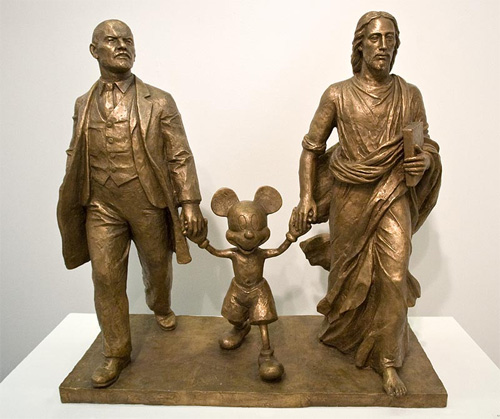
Thar She Blows!
I knew something was up when I saw the title of this New York Times op-ed by one Charles M. Blow: "Defecting to Faith." And I was right.Mr. Blow begins,
“Most people are religious because they’re raised to be. They’re indoctrinated by their parents.” So goes the rationale of my nonreligious friends. Maybe, but a study entitled “Faith in Flux” issued this week by the Pew Forum on Religion and Public Life questioned nearly 3,000 people and found that most children raised unaffiliated with a religion later chose to join one. Indoctrination be damned. By contrast, only 14 percent of those raised Catholic and 13 percent of those raised Protestant later became unaffiliated.I'm not especially surprised by that information, but I'm not sure it means much. "Indoctrination" doesn't come only from parents. My parents didn't impose a religion on me, but most of my peers came from churchgoing families and often invited me to services with them. This happened as early as elementary school. Sometimes I went, but I never stayed interested for long, and I had much less of a need to be like other people than most people seem to have. The United States is an especially church-ridden country, even if it's not as regimented as many religious conservatives would like, so religion is going to seem like a natural part of the landscape even if your family doesn't do it. And if your family doesn't go to church while most families do, a lot of people will grow up feeling left out. Most of us, even the unchurched, probably grew up with religious broadcasting, the presence of religion in art and literature, and even commercial entertainment will depict its characters in safely non-sectarian religious contexts at times, especially for weddings. Makes for nice eye-candy, and the ladies love the gowns.
In the interests of full disclosure, I should probably mention that I flirted with Buddhism in my twenties, mainly after reading the non-sectarian writings of Alan Watts. Watts made Buddhism attractive to an atheist like me as a philosophy, not a religion. I even tried Zen sitting a time or two, but always on my own. Once I realized that Buddhism was not a loose association of free spirits but a highly structured and authoritarian organized religion in its own right, I lost most of my interest in it. Part of its appeal, after all, was that it was not the dominant religion in the US; it had no associations of regressive political interference or puritanical social control here. I also twice attended silent Quaker meetings in my twenties, and found them impressive, but not enough to join. Later I learned that the Friends, despite their reputation for progressive social activism, are mostly pretty conservative.
I've also encountered a surprising number of atheists who say that they envy believers their "faith." I don't remember ever having felt that way. I've never felt that believers had something I didn't. Having had the bad taste to read writings by Christians, I noticed that the road of faith is often quite rocky. The word "faith" has splintered into various uses over time anyway. In the New Testament it mainly means trust in and loyalty to God, a sense which it still carries in "faithful." Even in the New Testament it gets used oddly, as in Hebrews 11.1, "Faith is the substance of things unseen, the evidence of things hoped for." Here, a dogged adherence to the church, even in the face of persecution or martyrdom, is a miraculous sign that Jesus is Lord. (This might be more convincing if Christians were less inclined to view such faith in members of competing sects as evidence that their competitors had the truth; instead they find it notably easy to denounce the fidelity of Jews, Muslims, "pagans," or different Christian groups as satanic perversity and stubbornness.) I'm not sure when "faith" became a euphemistic synonym for a particular religion or even denomination, as in "interfaith dialogue" or Eisenhower's "our form of government has no sense unless it is grounded in a deeply felt religious faith -- and I don't care what it is!" Mr. Blow evidently agrees: get thee to a church, any church, and find spiritual fulfillment there.
So I don't find it especially surprising that so many unaffiliated people relapse into religion. Not "faith," though, I'd say. Consider what that Pew study says: "Those who leave the ranks of the unaffiliated cite several reasons for joining a faith, such as the attraction of religious services and styles of worship (74%), having been spiritually unfulfilled while unaffiliated (51%) or feeling called by God (55%)." It's interesting that being "spiritually unfulfilled" is low man on the totem pole there, don't you think? Mr. Blow is a bit disingenuous in his summation of the reasons: "Most said that they first joined a religion because their spiritual needs were not being met. And the most-cited reason for settling on their current religion was that they simply enjoyed the services and style of worship." Fifty-one percent makes an odd "most," especially next to "most-cited." Besides, many of the affiliated feel spiritually unfulfilled in their churches of origin, which is why they leave them for different ones. "In total, about half of American adults have changed religious affiliation at least once during their lives," says the article Mr. Blow is citing. "Most people who change their religion leave their childhood faith before age 24, and many of those who change religion do so more than once." They already have "faith," presumably, as well as a faith, but it's not enough to satisfy them. Despite Mr. Blow's easy dismissal of this explanation, it's hard not to suspect that the grass looked greener on the other side.
As for "called by God," Mr. Blow adds parenthetically, "(It should be noted that about a quarter of the unaffiliated identified as atheist or agnostic, and the rest said that they had no particular religion.)" In other words, most of the unaffiliated are still theists of some kind. Which made me wonder how many of the unaffiliated who "defect to faith" had a religious upbringing after all, of a rather vague kind, and return to the fold after a period of disaffection? A famous example of this is the British scholar, Christian apologist, and writer of fiction, C. S. Lewis. He's notorious as an atheist who converted to Christianity and defended biblical inerrancy and the reality not only of God but of angels and devils; but his promoters tend to neglect to mention his Christian upbringing. His atheist period seems to have been mainly an adolescent/college phase, though it took him some time to formally return to the church.
"Spiritual fulfillment," whatever that may be, is not necessarily synonymous with "faith." It can be found in religions like Judaism, which stress observance rather than faith in the Christian mode, or in Hinduism or Buddhism. I think the appeal of ritual in religious services is key (that's what 74% of the formerly affiliated named as their main reason for getting religion. I understand that appeal, and I'm very fond of some forms of religious art (old choral music, for example, preferably in Latin or Church Slavonic so I can't understand the words), not so fond of others (Gothic depictions of emaciated Christs on the cross, say, or traditional white gospel music, or contemporary Christian pop). That's another reason why, despite Mr. Blow's dismissal, I suspect that a desire to fit in and belong played a role in many unaffiliated people's decision to join a church. Singing hymns with the rest of the congregation, praying in unison, the undeniable beauty of much religious art: sure, I see the appeal. If these things could be detached from dogma and blind conformism -- but they are in some ways inseparable, two sides of the same coin. I once disputed with someone who disliked organized religion and wanted to invent and practice his own rituals, but he didn't want to practice them alone. I pointed out that he would then be imposing his forms on the other participants, and before long he'd be running his own organized religion. If he let the other participants join in inventing the rituals, they wouldn't be his rituals, and he wouldn't have the freedom he said he wanted.
Some of my Christian friends challenge me: if there's no God, who created the world? What will happen to me after I die? How can I know right from wrong? In answer to the first two questions I insist: I don't know, and neither do they. To the third I respond that believing in God not only doesn't guarantee moral certainty -- believers constantly disagree among themselves -- but moral certainty itself is often destructive, as shown by some of the horrors perpetrated in the name of religion, or against it. If that kind of certainty is one of the results of "faith," then we are all better off without faith, however much we may want it.
Mr. Blow concedes numerous objections to religion, and brushes them aside: "Yes, yes, yes. But when is the choir going to sing? And when is the picnic? And is my child going to get a part in the holiday play?" And how can I stop your child from getting the part my child wants, or that I want her to get? Ah yes, church membership is a veritable hotbed of transcendence, peace, and harmony. Just like Little League.
Dale McGowan, the co-author and editor of the book “Parenting Beyond Belief” told me that he believes that most of these people “are not looking for a dogma or a doctrine, but for transcendence from the everyday.”That may well be true, but unfortunately when you join a religion you get the dogma and the doctrine whether you're looking for it or not; the transcendence is optional. The fact that so many people go from church to church is a reminder of how often religion fails to deliver it.
That being said, I want to agree with Mr. Blow's appeal to "the ethereal part of our human exceptionalism — that wondrous, precious part where logic and reason hold little purchase, where love and compassion reign." But also hatred and intolerance, which are as much a part of our ethereal part as the love and compassion. "It’s the part that fears loneliness, craves companionship and needs affirmation and fellowship. We are more than cells, synapses and sex drives. We are amazing, mysterious creatures forever in search of something greater than ourselves." Except that it's exactly those cells, synapses and sex drives that generate those cravings. Religion is not something that comes from outside human beings -- for good or bad, it's something we invented. Believers generally blame all that's wrong with religion on human frailty, while crediting what's right with it to their gods. I think we need to give ourselves credit as well as blame, and I don't think we can improve things until we do so.
(When I saw the image above today, I knew it belonged here; from Paradoxoff Planet via Agitprop.)
Dialogue Is Hard -- Let's Go Shopping!
The first question to put to such believers is: “How do you know what God wants? This believer over here says that God wants the opposite. How do I decide which one of you is telling the truth?” I’ve often asked exactly this of gay Christians. Why should I take their version of Christianity more seriously than I take Pat Robertson’s or Pope Rat’s? If they reply at all, it’s usually along the lines of, “Well, I never said you should!” So why did they pipe up in the first place?
Part of the problem is that the level of public discussion, especially in the
I’m not talking only about religious fundamentalists here, but about liberal Christians. Such people often complain that Christianity in
Or the exclusion can be a little more subtle. When Barack Obama invited a self-styled ex-gay gospel singer to participate in his election campaign, he chided his critics in an interview in The Advocate:
Part of the reason that we have had a faith outreach in our campaigns is precisely because I don't think the LGBT community or the Democratic Party is served by being hermetically sealed from the faith community and not in dialogue with a substantial portion of the electorate, even though we may disagree with them.
This is a revealing statement. Obama was saying that “the LBGT community” is “hermetically sealed from the faith community” and “not in dialogue” with it. As though “the LBGT community” contained no people of “faith”! (And with Obama and the other Democratic candidates waving their cult affiliations around, it’s equally dishonest to say that the Democratic Party is sealed off from the “faith community” as well.) That’s what antigay religious bigots would like you to believe, of course, but it’s not so. It’s primarily the antigay “faith community” that is not interested in “dialogue” with the rest of the electorate; they simply want to lay down the law – not to argue with their opponents, but to preach to them.
But I say “primarily” because in general the progay “faith community” is not much more interested in dialogue. Remember the gay minister I just mentioned. Or Joe Solmonese, the head of the Human Rights Campaign, who said that “There is no gospel in Donnie McClurkin’s message for gay, lesbian, bisexual and transgender people and their allies.”
For all that, the Human Rights Campaign fought its battle in press releases, not in action: “A vigil that was planned to protest outside of the concert included only about 20 people, almost all white, who held signs like "We are Here, We are Queer, we are voting next year," while across the street long lines of African-Americans, who seemed still dressed for church, waited to go into the event that started at 6 p.m.” But hey: dialogue is hard work, I’ll be the first to admit that.
Dialogue Is Hard -- Let's Go Shopping!
The first question to put to such believers is: “How do you know what God wants? This believer over here says that God wants the opposite. How do I decide which one of you is telling the truth?” I’ve often asked exactly this of gay Christians. Why should I take their version of Christianity more seriously than I take Pat Robertson’s or Pope Rat’s? If they reply at all, it’s usually along the lines of, “Well, I never said you should!” So why did they pipe up in the first place?
Part of the problem is that the level of public discussion, especially in the
I’m not talking only about religious fundamentalists here, but about liberal Christians. Such people often complain that Christianity in
Or the exclusion can be a little more subtle. When Barack Obama invited a self-styled ex-gay gospel singer to participate in his election campaign, he chided his critics in an interview in The Advocate:
Part of the reason that we have had a faith outreach in our campaigns is precisely because I don't think the LGBT community or the Democratic Party is served by being hermetically sealed from the faith community and not in dialogue with a substantial portion of the electorate, even though we may disagree with them.
This is a revealing statement. Obama was saying that “the LBGT community” is “hermetically sealed from the faith community” and “not in dialogue” with it. As though “the LBGT community” contained no people of “faith”! (And with Obama and the other Democratic candidates waving their cult affiliations around, it’s equally dishonest to say that the Democratic Party is sealed off from the “faith community” as well.) That’s what antigay religious bigots would like you to believe, of course, but it’s not so. It’s primarily the antigay “faith community” that is not interested in “dialogue” with the rest of the electorate; they simply want to lay down the law – not to argue with their opponents, but to preach to them.
But I say “primarily” because in general the progay “faith community” is not much more interested in dialogue. Remember the gay minister I just mentioned. Or Joe Solmonese, the head of the Human Rights Campaign, who said that “There is no gospel in Donnie McClurkin’s message for gay, lesbian, bisexual and transgender people and their allies.”
For all that, the Human Rights Campaign fought its battle in press releases, not in action: “A vigil that was planned to protest outside of the concert included only about 20 people, almost all white, who held signs like "We are Here, We are Queer, we are voting next year," while across the street long lines of African-Americans, who seemed still dressed for church, waited to go into the event that started at 6 p.m.” But hey: dialogue is hard work, I’ll be the first to admit that.
Subscribe to:
Posts (Atom)